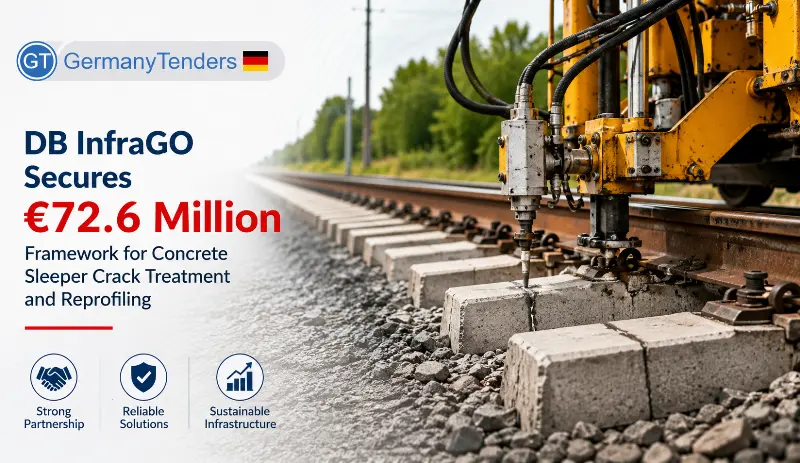
DB InfraGO Secures €72.6 Million Framework for Concrete Sleeper Crack Treatment and Reprofiling
23 Jul 2026
A framework agreement for crack treatment and reprofiling of concrete sleepers worth up to €72.6 million has been awarded by DB InfraGO AG. The contract, spanning two lots with multiple winners including Possehl Spezialbau GmbH, adicon dichte Bauwerke GmbH, and GETEK GmbH, demonstrates how Germany's railway infrastructure operator is maintaining the safety and reliability of its track network across the country. Introduction Every kilometre of railway track in Germany depends on concrete sleepers to maintain gauge and support the rails. Over time, these sleepers can develop cracks or suffer damage that requires treatment to prevent failure. DB InfraGO AG, Germany's railway infrastructure operator, has taken a significant step to maintain the safety of its network by awarding a new framework agreement for crack treatment and reprofiling of concrete sleepers. While not a headline-grabbing consumer deal, this contract is fundamental to ensuring the safety, reliability, and longevity of Germany's railway infrastructure. It reveals a great deal about how Deutsche Bahn maintains its track network through specialised maintenance frameworks. Why This Contract Matters DB InfraGO AG is responsible for operating and maintaining Germany's railway infrastructure, including approximately 33,000 kilometres of track, 5,000 stations, and numerous bridges, tunnels, and other structures. Concrete sleepers are a critical component of the track system, supporting the rails and maintaining the precise gauge required for safe train operation. Concrete sleepers can develop cracks over time due to stress, weather, and age. These cracks must be treated promptly to prevent failure. The framework agreement covers two treatment methods: injection (injektion) and grouting (verguss), as specified in DB's internal guideline Ril 824.3620. This specialised work can only be performed by service providers approved by DB InfraGO's track engineering department. Contract Timeline Contract award notice published: 23 July 2026 (OJ S 140/2026) Winner chosen: 17 July 2026 Contract concluded: 20 July 2026 Coverage start date: 1 November 2026 Coverage end date: 31 October 2030 (with 2 x 2-year renewal options) Contract Overview DB InfraGO AG conducted an open procedure for a framework agreement for crack treatment and reprofiling of concrete sleepers in special locations in tracks and switches, according to DB guideline Ril 824.3620. The contract is divided into two lots: Lot 1 – Injection: Treatment of cracks and reprofiling of damage in prestressed concrete sleepers using injection (Injektion) Lot 2 – Grouting: Treatment of cracks and reprofiling of damage in prestressed concrete sleepers using grouting (Verguss) The framework is a multi-supplier framework agreement with reopening of competition for individual call-offs. The maximum value of the framework is €72,570,978, with Lot 1 valued at €52,346,580 and Lot 2 at €20,224,399. The initial contract period is 4 years (November 2026 – October 2030), with two 2-year renewal options (maximum total duration of 8 years). Key Contract Details Detail Information Contracting Authority DB InfraGO AG – Geschäftsbereich Fahrweg (Bukr 16) Contract Subject Track construction works (CPV 45234116) – Crack treatment and reprofiling of concrete sleepers Procedure Type Open procedure Legal Basis Directive 2014/25/EU (Sector Directive), SektVO Maximum Framework Value €72,570,978.00 Lot 1 Maximum Value €52,346,580.00 Lot 2 Maximum Value €20,224,399.00 Number of Lots 2 Contract Duration 4 years + 2 x 2-year renewal options (max 8 years) Award Criteria Price (100%) Bids Received (Lot 1) 6 Bids Received (Lot 2) 7 EU Funding None disclosed Covered by GPA Yes Review Organisation Vergabekammer des Bundes Lots and Winners Lot Treatment Method Winners Rank LOT-0001 Injection (Injektion) GETEK GmbHPossehl Spezialbau GmbHadicon dichte Bauwerke GmbHKrebs GmbH & Co. KGHeinrich Schmid GmbH & Co. KGDB Bahnbau Gruppe GmbH 123456 LOT-0002 Grouting (Verguss) adicon dichte Bauwerke GmbHPossehl Spezialbau GmbHHeinrich Schmid GmbH & Co. KGVE-Log GmbHRhomberg Sersa Gleisbau GmbHKrebs GmbH & Co. KGDB Bahnbau Gruppe GmbH 1234567 About the Contracting Authority DB InfraGO AG is a subsidiary of Deutsche Bahn AG responsible for operating and maintaining Germany's railway infrastructure. The company manages approximately 33,000 kilometres of track, 5,000 stations, and numerous bridges, tunnels, and other railway structures. DB InfraGO ensures that Germany's railway network is safe, reliable, and efficiently maintained. The procurement was managed through Deutsche Bahn's central procurement function on behalf of DB InfraGO. About the Winning Companies Possehl Spezialbau GmbH is a medium-sized German construction company based in Sprendlingen, specialising in specialist civil engineering, track construction, and concrete repair. The company won both lots with ranks 2 and 2 respectively. adicon dichte Bauwerke GmbH is a medium-sized German company based in Hörsel, specialising in waterproofing and concrete repair for infrastructure projects. The company won both lots with ranks 3 and 1 respectively. GETEK Gesellschaft für innovative T - k GmbH is a medium-sized German company based in Rosengarten, specialising in innovative track construction and maintenance solutions. The company won Lot 1 with rank 1. Other winners include Krebs GmbH & Co. KG, Heinrich Schmid GmbH & Co. KG, DB Bahnbau Gruppe GmbH (Lot 1), Rhomberg Sersa Gleisbau GmbH, and VE-Log GmbH (Lot 2). Procurement Analysis Procedure: An open procedure was used, following the German Sector Procurement Regulation (SektVO) implementing Directive 2014/25/EU. Six bids were received for Lot 1 and seven for Lot 2. Competition: The multi-supplier framework structure with 6 winners for Lot 1 and 7 for Lot 2 reflects strong competition in the specialist railway maintenance sector. Award Criteria: Price was the sole award criterion with 100% weighting. This reflects the nature of the work where technical requirements and approval processes are clearly defined by DB's internal guidelines and regulatory approvals. Specialist Requirements: Bidders were required to hold or have applied for a valid user approval (Anwenderfreigabe) from DB InfraGO's track engineering department, in accordance with Ril 824.3620Z01. Materials used must be listed in the EBA's Eisenbahnspezifische Liste der Technischen Baubestimmungen (ELTB) and Eisenbahnspezifische Bauregelliste (EBRL). Framework Structure: The agreement is structured as a framework agreement with reopening of competition for individual call-offs. The maximum number of participants is unlimited. Renewal Options: The framework includes two 2-year renewal options, allowing for a maximum total duration of 8 years. Sanctions Compliance: The tender includes a reference to EU Regulation 2022/576, ensuring that companies subject to sanctions (related to Russia) are excluded from the procurement process. GPA Status: The procurement is covered by the World Trade Organization's Government Procurement Agreement (GPA), meaning it was, in principle, open to qualifying international bidders. Additional Procurement Facts The framework covers track construction works according to DB guideline Ril 824.3620. Bidders must have or have applied for a user approval from DB InfraGO's track engineering department. The framework includes two 2-year renewal options. Six bids for Lot 1 and seven for Lot 2 were received. All winners are German companies. No EU funding was used for this procurement. Disputes or review requests fall to the Vergabekammer des Bundes. Market & Industry Perspective The railway infrastructure maintenance market in Germany is specialised, with contractors requiring specific approvals from DB InfraGO to perform track maintenance work. The framework structure with multiple suppliers provides flexibility and competition for individual call-offs. The 100% price weighting reflects the nature of the work where technical requirements and quality standards are defined by DB's internal guidelines and regulatory approvals. Contractors who have the necessary approvals can compete primarily on price. The inclusion of sanctions compliance provisions reflects the EU's regulatory framework following Russia's actions in Ukraine, ensuring that public procurement is not used to benefit sanctioned entities. Economic Significance At up to €72.6 million over up to 8 years (including renewals), this framework agreement represents a significant investment in railway infrastructure maintenance. The contract ensures that concrete sleepers across Germany's railway network are treated and maintained to the highest safety standards. For the winning contractors, the framework provides a stable, multi-year revenue stream and the opportunity to serve Germany's largest railway infrastructure operator. Future Procurement Opportunities This framework agreement covers crack treatment and reprofiling through approximately 2034 (with renewals). Related procurement opportunities may include: Other track maintenance and renewal works Switch and crossing maintenance Ballast and track bed works Specialist railway engineering services Opportunities for Suppliers Companies active in the railway maintenance sector should note the importance of obtaining user approvals (Anwenderfreigabe) from DB InfraGO to participate in track maintenance procurements. The approval process can take several months, and bidders should plan accordingly. Key success factors include: obtaining and maintaining DB user approval, using materials listed in the EBA's ELTB and EBRL, competitive pricing, and the ability to deliver work nationwide across Germany. What Businesses Should Watch The exercise of the 2-year renewal options on this framework. Similar track maintenance procurements from DB InfraGO. Changes to DB's internal guidelines and EBA requirements. Opportunities for subcontracting with the framework winners. GermanyTender Procurement Intelligence This contract is a useful case study in how Germany's railway infrastructure operator maintains its track network through specialised maintenance frameworks. DB InfraGO has secured a €72.6 million framework for concrete sleeper crack treatment and reprofiling, with multiple winners selected through a price-based open procedure. The most notable feature of this tender is the specialist approval requirement. Bidders must hold or have applied for a user approval (Anwenderfreigabe) from DB InfraGO's track engineering department. The approval process can take several months, and contractors who do not already have approval should plan well in advance to participate. This creates a significant barrier to entry, ensuring that only qualified contractors can perform this safety-critical work. The 100% price weighting reflects the nature of the work where technical requirements are specified in detail by DB's internal guidelines and EBA regulations. With the technical requirements clearly defined and approval processes ensuring quality, price becomes the primary differentiator among qualified bidders. The multi-supplier framework structure provides DB InfraGO with flexibility to choose from a pool of qualified contractors for individual call-offs, while the price-based evaluation ensures cost efficiency. For suppliers, the lesson is that obtaining the necessary technical approvals is essential for participating in DB InfraGO maintenance tenders. Companies should invest in the approval process and maintain strong relationships with DB's track engineering department to ensure they can participate in future opportunities. Supplier Takeaways Obtain and maintain DB user approval (Anwenderfreigabe) – essential for participation. Materials must be listed in the EBA's ELTB and EBRL. Price is the sole award criterion (100%). Multi-supplier frameworks offer ongoing opportunities. Renewal options extend framework duration up to 8 years. Sanctions compliance (EU Regulation 2022/576) is required. Key Takeaways DB InfraGO awarded a €72.6 million framework for concrete sleeper crack treatment and reprofiling. Two lots: Injection (€52.3 million) and Grouting (€20.2 million) with multiple winners each. Award criteria: Price (100%). Six bids for Lot 1 and seven for Lot 2 were received. Contract duration: 4 years + 2 x 2-year renewal options (max 8 years). Specialist approval from DB InfraGO is required for participation. Conclusion This is not a contract that will make national headlines, but it reflects something structurally important about how Germany maintains its railway infrastructure. By awarding a €72.6 million framework for concrete sleeper crack treatment and reprofiling, DB InfraGO ensures that its track network remains safe and reliable for passengers and freight operations. The contract demonstrates the importance of specialist approvals, price competitiveness, and multi-supplier frameworks in railway infrastructure maintenance. Frequently Asked Questions Q: What is DB InfraGO AG? It is a subsidiary of Deutsche Bahn AG responsible for operating and maintaining Germany's railway infrastructure, including approximately 33,000 kilometres of track. Q: What does this framework cover? It covers crack treatment and reprofiling of concrete sleepers using injection and grouting methods, as specified in DB guideline Ril 824.3620. Q: What is required to participate? Contractors must hold or have applied for a user approval from DB InfraGO's track engineering department and use materials listed in the EBA's ELTB and EBRL. Q: What is the value of this framework? The maximum value is €72.6 million, with Lot 1 at €52.3 million and Lot 2 at €20.2 million. Q: Is this contract funded by the EU? No. The notice confirms the project is not financed with EU funds, though it is governed by EU Directive 2014/25/EU.Source: EU Official Journal, Contract Award Notice 510868-2026, OJ S 140/2026, published 23 July 2026.
View Details
City of Munich Secures Major Framework for Active Network Components (2027-2030)
22 Jul 2026
A framework agreement for active network components worth up to €162 million has been awarded by the City of Munich. The contract, won by Computacenter AG & Co oHG, demonstrates how major German cities are investing in critical IT infrastructure to support their digital transformation and public services. Introduction Every public service in a modern city relies on robust, secure, and high-performance network infrastructure. From online citizen services to internal government communications, from public safety systems to municipal operations, the City of Munich's digital backbone depends on active network components. The City has taken a significant step to ensure this infrastructure meets future demands by awarding a new framework agreement for active network components. While not a headline-grabbing consumer technology deal, this contract is fundamental to ensuring that Munich's digital infrastructure remains reliable, secure, and future-proof through 2030. It reveals a great deal about how major German cities are modernising their IT infrastructure through strategic procurement. Why This Contract Matters Munich is Germany's third-largest city and the capital of Bavaria, with a population of approximately 1.5 million residents. The City's IT infrastructure supports a vast range of services, including citizen portals, administrative systems, public safety networks, schools, libraries, and municipal utilities. The framework agreement covers active network components from Cisco Systems, the dominant provider in enterprise networking. The contract includes hardware supply, software and licenses, delivery, installation, support, and related services for the City's existing LAN and WAN infrastructure. This multi-year agreement ensures that Munich's network infrastructure can be maintained, upgraded, and expanded as needed. Contract Timeline Previous notice referenced: 211673-2026 Contract award notice published: 22 July 2026 (OJ S 139/2026) Contract concluded: 26 June 2026 Contract Overview The City of Munich conducted an open procedure for a framework agreement for active network components. The contract covers existing and new active network components from manufacturer Cisco Systems, including software, licenses, delivery, assembly, and support, as well as additional services for the City's existing LAN and WAN infrastructure. The maximum value of the framework agreement is €162,000,000, with an estimated value of €111,428,571.43. The contract duration is 48 months. The framework agreement is established with a single economic operator, Computacenter AG & Co oHG. The framework is without reopening of competition for individual call-offs. Key Contract Details Detail Information Contracting Authority Landeshauptstadt München, IT@M-BO4, Vergabemanagement Winning Bidder Computacenter AG & Co oHG Contract Subject Active network components (CPV 32000000, 32422000, 32420000, 32421000) Manufacturer Cisco Systems Procedure Type Open procedure Legal Basis Directive 2014/24/EU, VgV Estimated Value (ex-VAT) €111,428,571.43 Maximum Framework Value €162,000,000.00 Contract Duration 48 Months Award Criteria Price (100%) Bids Received 1 EU Funding None disclosed Covered by GPA Yes Review Organisation Regierung von Oberbayern, Vergabekammer Südbayern Project Scope The framework agreement covers a comprehensive range of services for the City of Munich's network infrastructure: Hardware Supply: Provision of active network components from Cisco Systems, including switches, routers, firewalls, wireless access points, and other network equipment. Software and Licenses: Supply of necessary software and licensing for network components. Delivery and Assembly: Delivery and installation of network components. Support and Maintenance: Third-level support, Technical Assistance Center (TAC) support from Cisco, and ongoing maintenance. Design and Consulting: Design, customisation, consulting, and support services. Configuration and Commissioning: Configuration, commissioning, and system familiarisation. Cabling and Patching: Patching cables, including 1:1 replacement for troubleshooting, delivery and patching for new installations or expansions. Decommissioning: Dismantling and disposal of old equipment. Data Management: Recording, changing, and incorporating user data and routing tables. About the Contracting Authority Landeshauptstadt München, IT@M-BO4, Vergabemanagement is the IT procurement unit of the City of Munich. The City of Munich is Germany's third-largest city with approximately 1.5 million residents, and one of Germany's most important economic and cultural centres. The City's IT infrastructure supports a vast range of public services, including citizen portals, administrative systems, public safety, education, and municipal utilities. The IT@M unit is responsible for managing the City's IT strategy, operations, and procurement. About the Winning Company Computacenter AG & Co oHG is a large German IT services and solutions provider, and a subsidiary of the international Computacenter Group, one of Europe's largest independent IT infrastructure providers. Based in Munich, Computacenter specialises in IT infrastructure, networking solutions, cloud services, and digital workplace solutions. The company has extensive experience in providing network infrastructure solutions for public sector clients, including government entities and large enterprises. Computacenter is listed on a regulated market. Procurement Analysis Procedure: An open procedure was used, following the German VgV (Procurement Regulation). One tender was received, submitted electronically. Competition: Only one bid was received for this contract, reflecting the specialised nature of the requirement for Cisco Systems equipment and services. The limited competition is typical for manufacturer-specific procurement, where the manufacturer's certified partners may be limited. Award Criteria: Price was the sole award criterion with 100% weighting. This reflects the nature of hardware procurement where technical specifications are clearly defined by the requirement for Cisco Systems equipment, making price the primary differentiator among qualified bidders. Strategic Procurement: The contract includes strategic procurement objectives focused on: Reduction of Environmental Impacts: Sustainable IT practices and environmental considerations in procurement. Fulfilment of Social Objectives: Accessibility for all, ethnic equality, gender equality, human rights due diligence in global supply chains, fair working conditions, and other social objectives. Framework Structure: The agreement is structured as a framework agreement without reopening of competition, meaning that the City of Munich can directly call off network components and services against the framework terms for the duration of the contract. Value Publication: The maximum value of the framework agreement is not published in the notice, as the contracting authority has determined that disclosure would harm the commercial interests of the successful bidder (in accordance with Article 50(4) of Directive 2014/24/EU and § 39(6) VgV). GPA Status: The procurement is covered by the World Trade Organization's Government Procurement Agreement (GPA), meaning it was, in principle, open to qualifying international bidders. Additional Procurement Facts Only one tender was received, from Computacenter AG & Co oHG. The framework covers Cisco Systems equipment exclusively. The contract duration is 48 months (4 years). No subcontracting was used by the winning bidder. The contract includes strategic procurement objectives for environmental and social sustainability. No EU funding was used for this procurement. Disputes or review requests fall to the Regierung von Oberbayern, Vergabekammer Südbayern (Government of Upper Bavaria, Procurement Chamber South Bavaria). Market & Industry Perspective The enterprise networking market is dominated by a small number of manufacturers, with Cisco Systems being the global leader. Public sector organisations often standardise on a single vendor to ensure interoperability, simplify management, and leverage volume discounts. The price-only award criterion (100% price) reflects the nature of this procurement, where the technical specifications are clearly defined by the requirement for Cisco Systems equipment and the range of services required. With the technical requirements specified, price becomes the primary differentiator among qualified Cisco partners. The inclusion of strategic procurement objectives for environmental and social sustainability reflects the growing importance of sustainability in German public procurement, even for IT infrastructure. This includes requirements for sustainable IT practices, human rights due diligence in supply chains, and fair working conditions. Economic Significance At up to €162 million, this framework agreement represents one of the largest IT infrastructure procurements by a German city in recent years. The contract ensures that Munich's network infrastructure remains modern, secure, and capable of supporting the City's digital transformation through 2030. For Computacenter, the framework provides a stable, multi-year revenue stream and a prestigious reference client in the German public sector. Future Procurement Opportunities This framework agreement covers network components through 2030. Related procurement opportunities may include: Network security solutions Cloud and data centre infrastructure IT consulting and digital transformation services Other IT infrastructure categories Other major German cities may adopt similar frameworks for network infrastructure, creating opportunities for suppliers with proven capabilities. Opportunities for Suppliers IT infrastructure providers active in the German public sector should note the growing demand for comprehensive network frameworks. Manufacturer-specific procurement (e.g., Cisco) requires suppliers to maintain strong partnerships with key manufacturers and demonstrate certified expertise. Key success factors include: competitive pricing, Cisco certification and partnership, proven experience in public sector network projects, the ability to deliver comprehensive services (hardware, software, installation, support, decommissioning), and demonstrated commitment to environmental and social sustainability. What Businesses Should Watch Similar network infrastructure procurements from other German cities and public sector organisations. The evolution of Cisco's product portfolio and certification requirements. Opportunities for subcontracting with Computacenter on this framework. The development of sustainability requirements in IT procurement. GermanyTender Procurement Intelligence This contract is a significant case study in how major German cities are investing in critical IT infrastructure. The City of Munich has secured a major framework agreement for active network components, with Computacenter selected as the winner through a price-based open procedure. The most notable feature of this tender is the single-bidder outcome. Only one tender was received, reflecting the specialised nature of the requirement for Cisco Systems equipment and the limited number of certified partners capable of delivering the full scope of services required. This highlights the importance of maintaining strong manufacturer relationships and certification for suppliers in this market. The 100% weighting for price reflects the nature of this procurement, where technical specifications are clearly defined by the manufacturer and the comprehensive scope of services. With the technical requirements specified, price becomes the primary differentiator among qualified bidders. The inclusion of strategic procurement objectives for environmental and social sustainability is noteworthy. Even for large IT infrastructure procurements, the City of Munich is embedding sustainability requirements, reflecting the broader trend toward sustainable public procurement in Germany. For suppliers, the lesson is that manufacturer certification and partnership are essential for manufacturer-specific procurement. Companies with strong manufacturer relationships and comprehensive service capabilities are best positioned for these large-scale infrastructure frameworks. Price competitiveness remains critical when technical requirements are clearly specified. Supplier Takeaways Manufacturer certification (Cisco) is essential for this market segment. Price is the sole award criterion (100%) when technical requirements are specified. Comprehensive service capabilities (hardware, software, installation, support) are required. Sustainability credentials (environmental and social) are increasingly important. Single-bidder tenders are common for manufacturer-specific procurement. Large-scale framework agreements offer multi-year revenue stability. Key Takeaways City of Munich awarded a major framework for active network components to Computacenter AG & Co oHG. The framework covers Cisco Systems equipment with a maximum value of €162 million. Award criteria: Price (100%). Only one bid was received, from Computacenter. Contract duration: 48 months (2027-2030). The contract includes strategic sustainability objectives for environmental and social responsibility. Conclusion This is not a consumer-oriented contract, but it reflects something structurally important about how major German cities are investing in critical IT infrastructure. By awarding a major framework agreement for active network components to Computacenter, the City of Munich ensures that its digital infrastructure remains modern, secure, and capable of supporting public services through 2030. The contract demonstrates the importance of manufacturer certification, price competitiveness, and sustainability in modern IT procurement. Frequently Asked Questions Q: What is the City of Munich's IT procurement unit? IT@M-BO4, Vergabemanagement is the unit responsible for managing the City of Munich's IT procurement, including the acquisition of network infrastructure and related services. Q: What does this framework cover? It covers active network components from Cisco Systems, including hardware, software, licenses, delivery, installation, support, decommissioning, and related services. Q: Who is the winning bidder? Computacenter AG & Co oHG, a large German IT services provider and Cisco partner. Q: What is the value of this framework? The maximum value is €162 million, with an estimated value of €111,428,571.43. The exact maximum value is not published to protect the commercial interests of the successful bidder. Q: Is this contract funded by the EU? No. The notice confirms the project is not financed with EU funds, though it is governed by EU Directive 2014/24/EU.Source: EU Official Journal, Contract Award Notice 505948-2026, OJ S 139/2026, published 22 July 2026.
View Details
NRW.BANK Secures €13.9 Million Framework Agreement for IT Expert Services
21 Jul 2026
A framework agreement for the provision of IT experts worth up to €13.9 million has been awarded by NRW.BANK AöR. The contract, won by four leading personnel service providers including Hays AG, FERCHAU Contract GmbH, Akkodis Germany Tech Freelance GmbH, and Etengo AG, demonstrates how Germany's public development banks are leveraging flexible IT expertise to support their digital transformation. Introduction Every modern financial institution depends on robust IT systems and expert personnel to develop, maintain, and secure its digital infrastructure. NRW.BANK, the development bank for North Rhine-Westphalia, requires flexible access to IT specialists to support its diverse range of projects and initiatives. The bank has taken a significant step to address this by awarding a new framework agreement for IT expert services. While not a headline-grabbing infrastructure deal, this contract is fundamental to ensuring that NRW.BANK can access the IT expertise it needs to fulfil its public mandate. It reveals a great deal about how German public financial institutions are modernising their IT capabilities through flexible procurement arrangements. Why This Contract Matters NRW.BANK is the development bank for North Rhine-Westphalia, Germany's most populous state. The bank supports the state in its structural and economic policy tasks, with three core funding areas: "Economy", "Housing", and "Infrastructure/Municipalities". The bank's activities include securing and improving the medium-sized structure of the economy, providing risk capital, supporting urban development, infrastructure measures, environmental protection, technology, and innovation measures. To fulfil this mandate, NRW.BANK requires flexible access to IT experts across diverse technology fields. The framework agreement enables the bank to engage freelancers and specialists on a project-by-project basis through mini-competitions, ensuring that the right expertise is available when needed. Contract Timeline Contract award notice published: 21 July 2026 (OJ S 138/2026) Date winner chosen: 29 April 2026 Contract concluded: 15 May 2026 Contract Overview NRW.BANK AöR conducted an open procedure for a framework agreement for IT experts. The contract covers the provision of IT freelancers and specialists to NRW.BANK on a project-by-project basis across various technology fields. The framework agreement is established with four partner companies. The maximum value of the framework agreement is €13,865,546.22 (approximately €16.4 million gross over the entire duration including extensions). The initial contract duration is 24 months, with the option for two renewals of 12 months each (maximum total duration of 48 months). Individual assignments are awarded through mini-competitions on the NRW procurement platform. There is no guaranteed minimum purchase obligation. Key Contract Details Detail Information Contracting Authority NRW.BANK AöR Winning Bidders Hays AG, FERCHAU Contract GmbH, Akkodis Germany Tech Freelance GmbH, Etengo AG Contract Subject IT services: consulting, software development, Internet and support (CPV 72000000) Procedure Type Open procedure Legal Basis Directive 2014/24/EU, VgV Maximum Framework Value €13,865,546.22 Contract Duration 2 years + 2 x 1-year renewal options (max 4 years) Number of Partners 4 Award Criteria Price (60%), Quality Concept (30%), Exemplary Skill Profiles (10%) Bids Received 20 EU Funding None disclosed Covered by GPA Yes Review Organisation Vergabekammer Westfalen Project Scope The framework agreement covers the provision of IT experts (freelancers) to NRW.BANK. The scope includes: IT Expert Placement: Provision of qualified IT freelancers and specialists to support NRW.BANK's IT projects and initiatives. Technology Areas: Experts are placed across diverse technology fields, including software development, IT consulting, infrastructure, security, and support. Project-Based Engagement: Freelancers are engaged on a project-by-project basis, providing flexibility for NRW.BANK to scale its IT capabilities. Mini-Competitions: Individual assignments are awarded through mini-competitions between the four framework partners. The framework agreement has no minimum purchase obligation, and the maximum call-off value is €16.4 million gross (including VAT) over the entire duration including extensions. About the Contracting Authority NRW.BANK AöR is the development bank for North Rhine-Westphalia, Germany's most populous state with over 17 million residents. The bank supports the state in its structural and economic policy tasks, operating in three core funding areas: "Economy" (supporting medium-sized businesses, start-ups, and risk capital), "Housing" (social housing support), and "Infrastructure/Municipalities" (urban development, infrastructure measures, environmental protection, technology, and innovation). NRW.BANK acts in the public interest, in a competitively neutral manner, and follows the "house bank procedure" in its cooperation with cooperative banks, private banks, and savings banks. About the Winning Companies Hays AG is a large German personnel services company based in Mannheim. Hays is one of the world's leading providers of recruitment and talent management services, with a strong focus on IT and technology professionals. The company has extensive experience in placing IT freelancers and specialists in the German public sector. FERCHAU Contract GmbH is a large German engineering and IT services company based in Unterhaching, near Munich. FERCHAU specialises in the placement of highly qualified engineers, IT specialists, and freelancers across various industries, including the public sector and financial services. Akkodis Germany Tech Freelance GmbH is a large German IT and technology consulting company based in Stuttgart. Akkodis provides IT consulting, engineering services, and freelance placement, serving clients across the public and private sectors. Etengo AG is a large German IT recruitment and talent management company based in Mannheim. Etengo specialises in the placement of IT specialists and freelancers, with a strong focus on the German financial services and public sectors. Procurement Analysis Procedure: An open procedure was used, following the German VgV (Procurement Regulation). Twenty tenders were received, all submitted electronically, indicating strong competition in the IT staffing market. Competition: Twenty bids were received for this contract, reflecting the highly competitive nature of the IT personnel services market in Germany. The high number of bidders provided NRW.BANK with a wide range of options. Award Criteria: Price was weighted at 60%, quality concept at 30%, and exemplary skill profiles at 10%. The 60% weighting for price reflects the importance of cost efficiency in IT staffing, while the quality criteria ensure that the framework partners can deliver high-quality freelancers with the right skills. Quality Concept Criteria: Bidders were required to submit a quality concept demonstrating their ability to recruit, vet, and place high-quality IT freelancers. This includes processes for sourcing, screening, and managing freelancers, as well as quality assurance measures. Exemplary Skill Profiles: Bidders were required to submit exemplary skill profiles for IT freelancers, demonstrating their understanding of the required competencies and their ability to match freelancers to specific technology areas. Framework Structure: The agreement is structured as a framework agreement with reopening of competition, with four partners. Individual assignments are awarded through mini-competitions between the partners on the NRW procurement platform. This hybrid structure provides flexibility while ensuring competition on individual assignments. Strategic Procurement: The contract includes strategic procurement objectives focused on fulfilling social objectives, specifically in accordance with the TVgG-NRW (Tariff Compliance Act for North Rhine-Westphalia), promoting fair working conditions. GPA Status: The procurement is covered by the World Trade Organization's Government Procurement Agreement (GPA), meaning it was, in principle, open to qualifying international bidders. However, all winning bidders were German companies. Additional Procurement Facts Twenty tenders were received, all submitted electronically. Four partners were selected for the framework agreement. The framework agreement has no minimum purchase obligation. The maximum call-off value is €13,865,546.22 (net) or approximately €16.4 million gross. The contract includes renewal options for up to two additional years. Individual assignments are awarded through mini-competitions on the NRW procurement platform. No EU funding was used for this procurement. Disputes or review requests fall to the Vergabekammer Westfalen. Market & Industry Perspective The IT personnel services market in Germany is highly competitive, with numerous providers offering recruitment, freelance placement, and consulting services. This framework agreement reflects the growing trend among public sector organisations to use flexible staffing models to access IT expertise. The 60% weighting for price reflects the importance of cost efficiency in IT staffing, while the 30% weighting for quality concept ensures that framework partners have robust recruitment and quality assurance processes. The 10% weighting for exemplary skill profiles ensures that partners understand the specific technical requirements of NRW.BANK. The social objectives criterion (TVgG-NRW) reflects the importance of fair working conditions and tariff compliance in public sector procurement, ensuring that freelancers and specialists placed through the framework are engaged under fair conditions. Economic Significance At up to €13.9 million (net), this framework agreement represents a significant investment in IT staffing for NRW.BANK. The agreement ensures that the bank has access to the IT expertise it needs to support its diverse range of projects and initiatives. For the four winning partners, the framework provides a stable, multi-year revenue stream and the opportunity to demonstrate their capabilities in the German public sector. Future Procurement Opportunities This framework agreement covers IT staffing for up to four years (including renewals). Related procurement opportunities may include: IT consulting services Software development projects Infrastructure and security services IT project management Other German development banks and public financial institutions may adopt similar frameworks for IT staffing, creating opportunities for suppliers with proven capabilities. Opportunities for Suppliers IT personnel service providers active in the German public sector should note the growing demand for flexible IT staffing frameworks. The framework structure with four partners provides multiple entry points for qualified suppliers. Key success factors include: competitive pricing, robust recruitment and quality assurance processes, deep understanding of the specific technology areas required, compliance with social criteria (TVgG-NRW), and the ability to deliver high-quality freelancers on demand. What Businesses Should Watch Whether NRW.BANK exercises the renewal options for this framework. Similar procurement opportunities from other public financial institutions. The evolution of technology areas and skill requirements. Opportunities for subcontracting or partnership with the four framework partners. GermanyTender Procurement Intelligence This contract is a useful case study in how German public financial institutions are leveraging flexible IT staffing frameworks to support their digital transformation. NRW.BANK has secured a €13.9 million framework for IT experts, with four partners selected through a competitive open procedure. The most interesting feature of this tender is the balanced award criteria: 60% price, 30% quality concept, and 10% exemplary skill profiles. This reflects the importance of cost efficiency while recognising that the quality of recruitment processes and the ability to understand specific technical requirements are critical to the success of the framework. The high number of bids (20) reflects the competitiveness of the IT staffing market in Germany. The selection of four partners provides NRW.BANK with a diverse pool of suppliers, while the mini-competition mechanism ensures competition on individual assignments. The inclusion of social objectives (TVgG-NRW) demonstrates the growing importance of fair working conditions and tariff compliance in German public procurement. This ensures that freelancers and specialists engaged through the framework are treated fairly and in compliance with labour regulations. For suppliers, the lesson is that price competitiveness is essential, but quality processes and compliance with social criteria are also critical. Companies that can demonstrate robust recruitment processes, deep technical understanding, and compliance with fair working conditions are best positioned for these frameworks. Supplier Takeaways Price is the most important criterion (60%). Quality concept (30%) demonstrates recruitment and quality assurance capabilities. Exemplary skill profiles (10%) show understanding of specific technology areas. Social objectives (TVgG-NRW) compliance is required. Framework agreements with four partners offer multiple entry points. Mini-competitions ensure competition on individual assignments. Key Takeaways NRW.BANK awarded a €13.9 million framework for IT experts to four partners. Winners: Hays AG, FERCHAU Contract GmbH, Akkodis Germany Tech Freelance GmbH, and Etengo AG. Award criteria: Price (60%), Quality Concept (30%), Exemplary Skill Profiles (10%). Twenty bids were received, with four German companies selected. Contract duration: 2 years + 2 x 1-year renewal options (max 4 years). The framework supports NRW.BANK's digital transformation and public mandate. Conclusion This is not a contract that will make national headlines, but it reflects something structurally important about how German public development banks are accessing the IT expertise they need to fulfil their mandates. By awarding a €13.9 million framework for IT experts to four leading personnel service providers, NRW.BANK ensures that it has flexible access to the IT specialists it needs to support its diverse range of projects and initiatives. The contract demonstrates the importance of price competitiveness, quality processes, and social compliance in modern public procurement. Frequently Asked Questions Q: What is NRW.BANK? It is the development bank for North Rhine-Westphalia, Germany's most populous state, supporting the state in its structural and economic policy tasks. Q: What does this framework cover? It covers the provision of IT experts (freelancers and specialists) to NRW.BANK across various technology fields. Q: Who are the four partners? Hays AG, FERCHAU Contract GmbH, Akkodis Germany Tech Freelance GmbH, and Etengo AG. Q: What is the value of this framework? The maximum value is €13,865,546.22 (net) or approximately €16.4 million gross over the entire duration including extensions. Q: Is this contract funded by the EU? No. The notice confirms the project is not financed with EU funds, though it is governed by EU Directive 2014/24/EU.Source: EU Official Journal, Contract Award Notice 503777-2026, OJ S 138/2026, published 21 July 2026.
View Details