Land Hessen has awarded a €12.69M PMO staff leasing contract to Gi Group Deutschland.
16 Sep 2026
Land Hessen, represented by the Hessische Zentrale für Datenverarbeitung, a regional authority responsible for general public services, has awarded a contract for the procurement of PMO specialists for project management of the State of Hesse via temporary employment (Arbeitnehmerüberlassung) to Gi Group Deutschland. The awarded value of the contract is €12,689,640.00, covering IT services including consulting, software development, Internet and support, with a duration from 31 August 2026 to 30 August 2028 and the option of two one-year extensions. The contract was awarded following an open procedure under the standard regime, governed by EU Directive 2014/24/EU. Introduction Land Hessen, represented by the Hessische Zentrale für Datenverarbeitung (HZD), a regional authority responsible for general public services, has conducted an open procedure for the procurement of PMO specialists for project management of the State of Hesse via temporary employment. The HZD carries out numerous projects and programmes, both internally and externally commissioned by customers. In each project there are tasks that require a well-functioning PMO (Project Management Office). Since the required in-house know-how cannot always be made available in sufficient capacity and quality in a timely manner, the contracting authority intends to conclude a framework agreement for project specialists for coordinating tasks and the management of small and sub-projects. The procurement is not financed with EU funds but is covered by the Government Procurement Agreement (GPA). The services under the framework agreement can be called off up to a maximum value of €12,689,640.00 (net) with a maximum term of four years. If this maximum value is reached, the framework agreement ends without the need for separate termination. The evaluation is based on quality (60%) and price (40%). Fifteen tenders were received, of which six were from micro, small or medium tenderers, and one winner was appointed. Why This Contract Matters This framework ensures that the Hessische Zentrale für Datenverarbeitung has access to qualified PMO specialists for project management of the State of Hesse. This contract matters because it: Supports State IT Project Management: Provides PMO specialists for project management Significant Value: €12,689,640.00 maximum framework value Long-Term Commitment: 31 August 2026 to 30 August 2028, with up to two one-year extensions Quality Focus: 60% quality, 40% price Strong Competition: 15 tenders received SME Participation: 6 of 15 tenderers were SMEs Temporary Employment: Staff provided via Arbeitnehmerüberlassung Contract Timeline Contract concluded: 31 August 2026 Start date: 31 August 2026 Duration end date: 30 August 2028 Maximum renewals: 2 (one year each) Notice published: 16 September 2026 (OJ S 179/2026) Notice dispatch date: 14 September 2026 Contract Overview Land Hessen, represented by the Hessische Zentrale für Datenverarbeitung, conducted an open procedure under the standard regime, governed by EU Directive 2014/24/EU. Key features include: One lot: LOT-0000 Estimated value: €12,689,640.00 Maximum framework value: €12,689,640.00 Duration: 31 August 2026 to 30 August 2028 Maximum renewals: 2 (one year each) Framework type: Framework agreement, without reopening of competition Evaluation: Quality (60%) and Price (40%) Winner: Gi Group Deutschland (large enterprise) Subcontracting: No No EU funding Covered by GPA: Yes Strategic procurement: No strategic procurement Key Contract Details Main classification: 72000000 IT services: consulting, software development, Internet and support Place of performance: Wiesbaden (DE714), Frankfurt am Main (DE712), Hünfeld (DE732), Germany Procedure identifier: bc73c480-dc15-4da0-9195-4ca46cffb2eb Internal identifier: VG-3000-2026-0031 Type of procedure: Open Accelerated procedure: No Legal basis: Directive 2014/24/EU; VgV Review body: Vergabekammer des Landes Hessen beim Regierungspräsidium Darmstadt Lot Structure Lot 1 – PMO Specialists for Project Management Title: Beschaffung von PMO-Fachkräften für das Projekt Management des Landes Hessen in Arbeitnehmerüberlassung Description: Procurement of PMO specialists for project management of the State of Hesse via temporary employment Internal identifier: LOT-0000 Estimated value: €12,689,640.00 Maximum framework value: €12,689,640.00 Winner: Gi Group Deutschland Tenders received: 15 Contract concluded: 31 August 2026 Duration: 31 August 2026 to 30 August 2028, with up to two one-year extensions Lot Summary Table Lot Title Value (€) Winner Tenders 1 PMO Specialists for Project Management 12,689,640.00 Gi Group Deutschland 15 Total 12,689,640.00 Scope of Supply The framework covers the following services: PMO Support: Support of the project management or PMO management Project Description: Preparation of a concrete project description with objectives, risks and key players Interfaces: Maintenance of interfaces to other projects Project Structure: Support in creating project structure plan and project organisation chart Planning: Support in rough planning of costs, efforts and deadlines Requirements: Support in requirements definition Scheduling: Support in creating a schedule and activity plan Resource Planning: Support in effort and resource planning Communication: Support in communication planning Quality and Documentation: Support in quality assurance and documentation plan Status: Status collection (actual data and forecast values) Control Measures: Maintenance of control measures Controlling: Controlling of QA and result documentation Project Plans: Maintenance of project plans using MS-Project and Excel Project Manager Support: Support in sub-tasks of a project manager or programme manager Coordination: Deadline coordination and status tracking Minutes: Recording of project meetings Special Procurement Conditions Temporary Employment: Staff provided via Arbeitnehmerüberlassung (temporary employment) Maximum Value: Services can be called off up to a maximum value of €12,689,640.00 (net) with a maximum term of four years; if reached, the framework agreement ends without separate termination Eligibility Evidence: Applicants may provide proof of suitability and absence of exclusion grounds wholly or partly through participation in pre-qualification systems Declarations: Bidders must submit self-declarations on exclusion grounds (§§ 123, 124 GWB), Article 5k EU Regulation 833/2014, and company data Register Queries: Corruption and procurement register queries will be made for the intended contractor, members of bidding consortia and named subcontractors Competition Register: A competition register query will be requested before award Working Hours: Monday to Thursday 8:00-16:30; Friday 8:00-15:00 Place of Performance: Current and future HZD locations in Wiesbaden, Hünfeld and Mainz, plus the FITKO location in Frankfurt am Main Call-off Authorisation: Only the HZD is authorised to call off the services; HZD and, with HZD's consent, FITKO are entitled to use them No Subcontracting: No subcontracting declared by winner About the Contracting Authority Land Hessen, represented by the Hessische Zentrale für Datenverarbeitung, is a regional authority responsible for general public services. The organisation acts as a central purchasing body awarding public contracts or concluding framework agreements for works, supplies or services intended for other buyers. Legal type: Regional authority Activity: General public services Registration number: 06-25153000-14 Location: Wiesbaden, Germany (NUTS: DE714) Address: Mainzer Straße 29, 65185 Wiesbaden Email: vergabestelle@hzd.hessen.de Telephone: +49 611340 0 Fax: +49 611340 1150 Internet address: https://vergabe.hessen.de About the Winning Supplier Gi Group Deutschland is a large enterprise based in Düsseldorf, Germany, specialising in HR and temporary employment services. Size: Large enterprise Registration number: DE258752665 Location: Düsseldorf, Germany (NUTS: DEA11) Address: Emmericher Straße 26, 40474 Düsseldorf Email: tender.germany@gigroup.com Telephone: +49 15167276348 Fax: +49 211 35590699 Beneficial owner nationality: Italy Subcontracting: No Evaluation Criteria The lot uses the following evaluation criteria: Quality (60%): Performance – Concept Price (40%): Price Method: The evaluation of tenders is carried out by adding the weighted scores for price and performance. The bidder with the highest score (Z) has submitted the most economically advantageous tender overall and receives the award. Procurement Analysis Procedure: Open procedure under the standard regime, governed by EU Directive 2014/24/EU Competition: 15 tenders received (6 from micro, small or medium tenderers) Subcontracting: No subcontracting declared No EU funding: The procurement was not financed with EU funds Framework agreement: Framework agreement, without reopening of competition No dynamic purchasing system used Accelerated procedure: No Strategic procurement: No strategic procurement Review body: Vergabekammer des Landes Hessen beim Regierungspräsidium Darmstadt Call for competition terminated: The call for competition has been terminated (contract awarded) Additional Procurement Facts The contract is covered by the WTO's Government Procurement Agreement (GPA) No EU funds were used for this procurement The estimated value is €12,689,640.00 The maximum framework value is €12,689,640.00 The procurement is divided into one lot Quality (60%) and Price (40%) are the evaluation criteria Fifteen tenders were received, six from SMEs The winner is a large enterprise No subcontracting was declared The contract duration is 31 August 2026 to 30 August 2028, with up to two one-year extensions Staff provided via temporary employment (Arbeitnehmerüberlassung) Working hours: Monday-Thursday 8:00-16:30; Friday 8:00-15:00 Market & Industry Perspective The German public sector IT project management and staff leasing market features a mix of large staffing companies and specialised consultancies. PMO specialists are essential for ensuring quality assurance and compliance with state project work guidelines. Key trends in this market include: Quality focus: 60% quality, 40% price Large providers: Dominance of large staffing companies SME participation: 6 of 15 tenderers were SMEs Temporary employment: Staff leasing as a delivery model Long-term frameworks: Up to four years IT project management: PMO roles for state IT projects Economic Significance At €12,689,640.00, this framework represents a significant investment in PMO specialists for project management of the State of Hesse. The contract will: Support State IT Project Management: Provide PMO specialists for project management Support Large Enterprise: Gi Group Deutschland is a large staffing company Provide Long-Term Stability: Up to four-year framework Ensure Supply Security: Framework agreement with one supplier Enable Operational Efficiency: Standardised PMO support for state projects Support SME Participation: 6 of 15 tenderers were SMEs Future Procurement Opportunities With this framework now in place, future opportunities include: Re-tender: Expected after the maximum four-year duration Related Services: Additional IT project management and PMO services Subcontracting: Potential opportunities with Gi Group Deutschland Other State IT Projects: Similar procurement opportunities Framework Call-offs: Opportunities through HZD and FITKO Opportunities for Suppliers While this contract is awarded, opportunities remain for IT project management providers: Re-tender: Prepare for the next procurement cycle Subcontracting: Potential opportunities with Gi Group Deutschland Related Services: Other IT project management and PMO services Other German Federal and State Authorities: Similar PMO procurements Framework Call-offs: Monitor HZD and FITKO opportunities What Businesses Should Watch Land Hessen and HZD's future procurement notices Other German state IT project management tenders PMO and IT project management market trends Changes to German procurement regulations Temporary employment (Arbeitnehmerüberlassung) requirements Working hour and place of performance requirements GermanyTenders Procurement Intelligence This PMO staff leasing contract is a notable example of German public sector IT procurement. Several features stand out: Scale: €12.69M over up to four years Quality focus: 60% quality, 40% price Large winner: Gi Group Deutschland One lot: PMO specialists for project management Temporary employment: Staff leasing model Competition: 15 tenders received, 6 from SMEs Long-term framework: Up to four years For suppliers, this procurement highlights the importance of: Quality: 60% quality-based evaluation (concept) Competitive pricing: 40% price-based evaluation PMO expertise: Ability to provide qualified PMO specialists Certification requirements: PM certifications (PRINCE2, GPM/IPMA, PMI, SCRUM) Public sector experience: Understanding of German state project management requirements Temporary employment: Compliance with Arbeitnehmerüberlassung requirements Supplier Takeaways Ensure high quality – 60% of evaluation is quality-based (concept) Offer competitive pricing – 40% of evaluation is price-based Demonstrate PMO expertise and relevant certifications Develop public sector experience with German state authorities Demonstrate scale capability for staff leasing Monitor Land Hessen and HZD procurement opportunities Ensure compliance with temporary employment requirements Key Takeaways Land Hessen, represented by the Hessische Zentrale für Datenverarbeitung, awarded a €12,689,640.00 PMO staff leasing contract to Gi Group Deutschland One lot: PMO specialists for project management of the State of Hesse via temporary employment Duration: 31 August 2026 to 30 August 2028, with up to two one-year extensions Evaluation: Quality (60%) and Price (40%) 15 tenders received, 6 from SMEs Winner is a large enterprise No subcontracting declared No EU funding Covered by GPA: Yes Framework without reopening of competition Staff provided via Arbeitnehmerüberlassung Conclusion This PMO staff leasing framework ensures that the Hessische Zentrale für Datenverarbeitung has access to qualified PMO specialists for project management of the State of Hesse. By awarding the contract to Gi Group Deutschland, the HZD secures a reliable supplier with the scale and capability to deliver PMO expertise via temporary employment. The 60% quality and 40% price evaluation reflects the importance of both concept quality and cost in PMO staff leasing procurement, where the expertise of the personnel is a primary differentiator among qualified suppliers. The temporary employment model and the maximum value clause reflect the specific operational and budgetary context of state IT project management. For suppliers, this procurement highlights the importance of quality, competitive pricing, PMO expertise, certification requirements, public sector experience, and temporary employment compliance in winning German public sector PMO staff leasing contracts. Frequently Asked Questions Q: What is Land Hessen, represented by the Hessische Zentrale für Datenverarbeitung? Ans: A regional authority responsible for general public services, acting as a central purchasing body for the State of Hesse. Q: What is the value of the framework? Ans: Estimated and maximum framework value €12,689,640.00. Q: Who is the winner? Ans: Gi Group Deutschland, a large enterprise based in Düsseldorf, Germany. Q: What services are covered? Ans: PMO specialists for project management, including support of project management, project descriptions, planning, scheduling, resource planning, communication, quality assurance, documentation, controlling, and meeting minutes. Q: What were the evaluation criteria? Ans: Quality (60%) – Concept, and Price (40%). Q: How long is the contract? Ans: 31 August 2026 to 30 August 2028, with up to two one-year extensions (maximum four years). Q: How many tenders were received? Ans: Fifteen tenders, six from micro, small or medium tenderers. Q: Is this contract funded by the EU? Ans: No, the procurement is not financed with EU funds. Q: What is the review body? Ans: Vergabekammer des Landes Hessen beim Regierungspräsidium Darmstadt. Q: What is the lot structure? Ans: One lot – LOT-0000 (Beschaffung von PMO-Fachkräften für das Projekt Management des Landes Hessen in Arbeitnehmerüberlassung). Q: Is subcontracting allowed? Ans: No subcontracting was declared by the winner. Q: What is the delivery model? Ans: Staff provided via Arbeitnehmerüberlassung (temporary employment). Q: What certifications are required for PMO staff? Ans: At least one of APMG PRINCE2 Foundation, GPM/IPMA Level D, PMI CAPM, SCRUM Foundation, or comparable certification. Q: What are the places of performance? Ans: Current and future HZD locations in Wiesbaden, Hünfeld and Mainz, plus the FITKO location in Frankfurt am Main. Source: EU Official Journal, Contract Award Notice 636797-2026, OJ S 179/2026, published 16 September 2026. ```
View Details
European Commission, DG BUDG – Budget, has closed the €700M DIMOS VII financial IT systems tender without selecting a winner for both lots.
15 Sep 2026
European Commission, DG BUDG – Budget, on behalf of numerous EU institutions, bodies and agencies, has conducted an open procedure for the Development, Implementation, Maintenance and Operation of financial IT Systems (DIMOS VII) covering 27 European countries. The procurement was divided into two lots: Lot 1 (profiles focused on SAP-based technology systems) with an estimated value of €270,000,000.00, and Lot 2 (profiles focused on Financial Interoperable systems) with an estimated value of €430,000,000.00, giving a total estimated value of €700,000,000.00. Both lots were closed without a winner, and the competition is closed. The procedure was conducted under the standard regime, governed by Regulation (EU, Euratom) 2024/2509. Introduction European Commission, DG BUDG – Budget, on behalf of numerous EU institutions, bodies and agencies, has conducted an open procedure for the Development, Implementation, Maintenance and Operation of Financial IT Systems ("DIMOS VII"). The procurement covers 27 European countries: Austria, Belgium, Bulgaria, Cyprus, Czechia, Germany, Denmark, Spain, Estonia, Finland, France, Greece, Croatia, Hungary, Ireland, Italy, Lithuania, Luxembourg, Latvia, Malta, Netherlands, Poland, Portugal, Romania, Slovakia, Slovenia, and Sweden. The procurement was conducted under the standard regime, governed by Regulation (EU, Euratom) 2024/2509. The procurement is fully or partially financed with EU funds and is covered by the Government Procurement Agreement (GPA). The Foreign Subsidies Regulation applies, requiring economic operators to notify the contracting authority of all foreign financial contributions of at least EUR 4 million per third country received in the last three years. The framework agreement operates partly without reopening and partly with reopening of competition. Both lots resulted in no winner being chosen and the competitions were closed, with the reason being a decision of the buyer not to follow a tenderer's request to review the award, because of technical or procedural errors. Zero tenders were received for each lot. Why This Contract Matters This procurement was intended to ensure that the European Commission and numerous EU institutions, bodies and agencies have access to reliable development, implementation, maintenance and operation services for financial IT systems across Europe. This contract matters because it: Supports EU Financial IT: Development, implementation, maintenance and operation of financial IT systems Significant Value: €700,000,000.00 total estimated value Long-Term Commitment: 48-month duration Two Lots: SAP-based technology systems and Financial Interoperable systems Price Focus: 100% price-based evaluation Multi-Country Coverage: 27 European countries No Winner Selected: Both lots closed without a winner Contract Timeline Estimated duration: 48 months (per lot) Notice published: 15 September 2026 (OJ S 178/2026) Notice dispatch date: 11 September 2026 Previous notice: 612350-2026; 446891-2026 Contract Overview European Commission, DG BUDG – Budget, conducted an open procedure under the standard regime, governed by Regulation (EU, Euratom) 2024/2509. Key features include: Two lots: LOT-0001 and LOT-0002 Total estimated value: €700,000,000.00 Lot 1 estimated value: €270,000,000.00 Lot 2 estimated value: €430,000,000.00 Duration: 48 months Framework type: Framework agreement, partly without reopening and partly with reopening of competition Evaluation: Price (100%) Winners: No winner was chosen (both lots) Subcontracting: Not applicable EU funding: Fully or partially financed with EU funds Covered by GPA: Yes Key Contract Details Main classification: 72000000 IT services: consulting, software development, Internet and support Place of performance: 27 European countries (anywhere in the given country) Procedure identifier: 966981b6-1f69-46a6-b4c9-17a2079928ba Internal identifier: EC-BUDG/2026/OP/0006 Type of procedure: Open Legal basis: Regulation (EU, Euratom) 2024/2509 Review body: Court of Justice of the European Union Lot Structure Lot 1 – Profiles Focused on SAP-Based Technology Systems Title: profiles focused on SAP-based technology systems Description: Development, Implementation, Maintenance and Operation of financial IT Systems ("DIMOS VII") Internal identifier: EC-BUDG/2026/OP/0006-LOT-1 Estimated value: €270,000,000.00 Duration: 48 months Result: No winner was chosen and the competition is closed Tenders received: 0 Lot 2 – Profiles Focused on Financial Interoperable Systems Title: profiles focused on Financial Interoperable systems Description: Development, Implementation, Maintenance and Operation of financial IT Systems ("DIMOS VII") Internal identifier: EC-BUDG/2026/OP/0006-LOT-2 Estimated value: €430,000,000.00 Duration: 48 months Result: No winner was chosen and the competition is closed Tenders received: 0 Lot Summary Table Lot Title Estimated Value (€) Winner Tenders 1 SAP-Based Technology Systems 270,000,000.00 No winner chosen 0 2 Financial Interoperable Systems 430,000,000.00 No winner chosen 0 Total 700,000,000.00 Scope of Supply The framework covers the following services: Development: Development of financial IT systems Implementation: Implementation of financial IT systems Maintenance: Maintenance of financial IT systems Operation: Operation of financial IT systems Lot 1: Profiles focused on SAP-based technology systems Lot 2: Profiles focused on Financial Interoperable systems Special Procurement Conditions Foreign Subsidies Regulation: Economic operators must notify the contracting authority of all foreign financial contributions of at least EUR 4 million per third country received in the last three years Declaration Requirement: A declaration is necessary to confirm that no foreign financial contributions were received when applicable Form FS-PP: Notifications or declarations submitted using the Form FS-PP Framework Agreement: Partly without reopening and partly with reopening of competition No Winner: Both lots closed without a winner due to technical or procedural errors No Tenders: Zero tenders were received for each lot About the Contracting Authority European Commission, DG BUDG – Budget, is an EU institution, body or agency responsible for general public services. The organisation acts as group leader and central purchasing body awarding public contracts or concluding framework agreements for works, supplies or services intended for other buyers. Legal type: EU institution, body or agency Activity: General public services Registration number: COM Location: Brussels, Belgium (NUTS: BE100) Address: Rue de la Loi 200, B-1049 Brussels Email: BUDG-PROCUREMENT-CELL@ec.europa.eu Telephone: +32 2 299 11 11 Internet address: https://ec.europa.eu/info/departments/budget_en Other Buyers: The procurement was conducted on behalf of numerous EU institutions, bodies and agencies including the European Parliament, EEAS, General Secretariat of the Council, ERC Executive Agency, EISMEA, REA, HaDEA, BEREC Office, AMLA, CBE JU, CPVO, Europe's Rail JU, ECCC, EDA, EEA, EFCA, EFSA, Eurofound, EuroHPC JU, ELA, EPPO, European Schools, ESMA, CEPOL, EUAA, Eurojust, ENISA, FRA, Europol, ERA, ACER, eu-LISA, EUDA, Global Health EDCTP3 JU, IHI JU, SRB, Committee of the Regions, and the European Economic and Social Committee. About the Winning Supplier No winner was chosen for either lot. The competitions were closed without a winner due to a decision of the buyer, not following a tenderer's request to review the award, because of technical or procedural errors. Zero tenders were received for each lot. Evaluation Criteria Both lots use the following evaluation criterion: Price (100%): Price (please consult the procurement documents) Procurement Analysis Procedure: Open procedure under the standard regime, governed by Regulation (EU, Euratom) 2024/2509 Competition: 0 tenders received per lot Subcontracting: Not applicable EU funding: The procurement is fully or partially financed with EU funds Framework agreement: Framework agreement, partly without reopening and partly with reopening of competition No dynamic purchasing system used Strategic procurement: No strategic objectives specified Review body: Court of Justice of the European Union Call for competition terminated: Both lots closed without a winner Additional Procurement Facts The contract is covered by the WTO's Government Procurement Agreement (GPA) The procurement is fully or partially financed with EU funds The total estimated value is €700,000,000.00 Lot 1 estimated value is €270,000,000.00 Lot 2 estimated value is €430,000,000.00 The procurement is divided into two lots Price (100%) is the evaluation criterion Zero tenders were received for each lot No winner was chosen for either lot The contract duration is 48 months Foreign Subsidies Regulation applies Market & Industry Perspective The EU public sector financial IT systems market features specialised IT service providers. Development, implementation, maintenance and operation of financial IT systems are essential for the European Commission and numerous EU institutions, bodies and agencies. Key trends in this market include: Price focus: 100% price-based evaluation Large-scale frameworks: Up to €700M total estimated value Multi-country coverage: 27 European countries Long-term contracts: 48-month duration SAP and interoperability focus: Two specialised lots Regulatory compliance: Foreign Subsidies Regulation requirements No winner outcome: Both lots closed without a winner Economic Significance At €700,000,000.00, this procurement represented a significant investment in financial IT systems for the European Commission and numerous EU institutions, bodies and agencies. However, both lots were closed without a winner, meaning no contract was awarded. The procurement will: Support EU Financial IT: Intended to provide development, implementation, maintenance and operation services Support Large Enterprises: Intended for large IT service providers Provide Long-Term Stability: Intended 48-month framework Ensure Supply Security: Intended multi-supplier framework No Award Outcome: Both lots closed without a winner Potential Re-tender: Future procurement may be required Future Procurement Opportunities With this procurement closed without a winner, future opportunities include: Re-tender: Expected due to closure without a winner Related Services: Additional financial IT systems services Subcontracting: Potential opportunities with future winners Other EU IT Projects: Similar IT services procurement opportunities Framework Call-offs: Opportunities through future frameworks Opportunities for Suppliers As this procurement closed without a winner, significant opportunities remain for IT service providers: Re-tender: Prepare for the next procurement cycle Subcontracting: Potential opportunities with future winners Related Services: Other financial IT systems services Other EU Institutions: Similar IT services procurements Framework Call-offs: Monitor future framework opportunities What Businesses Should Watch European Commission DG BUDG's future procurement notices Re-tender of the DIMOS VII financial IT systems procurement Other EU financial IT systems tenders IT services market trends in the EU public sector Changes to EU procurement regulations Foreign Subsidies Regulation requirements GermanyTenders Procurement Intelligence This financial IT systems procurement is a notable example of EU public sector procurement. Several features stand out: Scale: €700M total estimated value over 48 months Price focus: 100% price-based evaluation Two lots: SAP-based technology systems and Financial Interoperable systems Multi-country coverage: 27 European countries No winner: Both lots closed without a winner No tenders: Zero tenders received per lot Regulatory compliance: Foreign Subsidies Regulation applies For suppliers, this procurement highlights the importance of: Competitive pricing: 100% price-based evaluation SAP expertise: For Lot 1 – SAP-based technology systems Interoperability expertise: For Lot 2 – Financial Interoperable systems Public sector experience: Understanding of EU financial IT requirements Scale capability: Ability to deliver large-scale IT projects across 27 countries Regulatory awareness: Understanding of Foreign Subsidies Regulation Supplier Takeaways Offer competitive pricing – 100% of evaluation is price-based Demonstrate SAP expertise for Lot 1 opportunities Demonstrate interoperability expertise for Lot 2 opportunities Develop public sector experience with EU institutions and agencies Demonstrate scale capability for multi-country IT projects Monitor European Commission DG BUDG and EU IT procurement opportunities Prepare for potential re-tender of DIMOS VII Key Takeaways European Commission, DG BUDG – Budget, conducted the DIMOS VII financial IT systems procurement with a total estimated value of €700,000,000.00 Two lots: SAP-based technology systems (€270M) and Financial Interoperable systems (€430M) Duration: 48 months per lot Evaluation: Price (100%) 0 tenders received per lot No winner was chosen for either lot and the competitions are closed Reason: Decision of the buyer, not following a tenderer's request to review the award, because of technical or procedural errors EU funding: Fully or partially financed with EU funds Covered by GPA: Yes Foreign Subsidies Regulation applies Coverage: 27 European countries Conclusion This financial IT systems procurement, intended to ensure that the European Commission and numerous EU institutions, bodies and agencies have access to reliable development, implementation, maintenance and operation services for financial IT systems, was closed without a winner for both lots. Despite the significant estimated value of €700,000,000.00 and the 48-month framework duration, zero tenders were received, and the buyer decided not to follow a tenderer's request to review the award due to technical or procedural errors. The 100% price-based evaluation reflects the competitive nature of financial IT systems procurement, where price is the primary differentiator among qualified suppliers. The multi-country coverage and the Foreign Subsidies Regulation requirements reflect the complexity and regulatory context of EU-level IT procurement. For suppliers, this procurement highlights the importance of competitive pricing, SAP and interoperability expertise, public sector experience, and scale capability in winning EU public sector financial IT systems contracts. The closure without a winner also signals potential re-tender opportunities in the future. Frequently Asked Questions Q: What is the European Commission, DG BUDG – Budget? Ans: An EU institution, body or agency responsible for general public services, acting as group leader and central purchasing body for the European Commission and other EU bodies. Q: What is the value of the framework? Ans: Total estimated value €700,000,000.00 (Lot 1: €270,000,000.00; Lot 2: €430,000,000.00). Q: Who is the winner? Ans: No winner was chosen for either lot; both competitions are closed. Q: What services are covered? Ans: Development, Implementation, Maintenance and Operation of financial IT Systems ("DIMOS VII"), across two lots: SAP-based technology systems and Financial Interoperable systems. Q: What were the evaluation criteria? Ans: Price (100%). Q: How long is the contract? Ans: 48 months per lot. Q: How many tenders were received? Ans: Zero tenders per lot. Q: Is this contract funded by the EU? Ans: Yes, the procurement is fully or partially financed with EU funds. Q: What is the review body? Ans: Court of Justice of the European Union. Q: What is the lot structure? Ans: Two lots – LOT-0001 (SAP-based technology systems) and LOT-0002 (Financial Interoperable systems). Q: Why was no winner chosen? Ans: Decision of the buyer, not following a tenderer's request to review the award, because of technical or procedural errors. Q: What countries are covered? Ans: 27 European countries: Austria, Belgium, Bulgaria, Cyprus, Czechia, Germany, Denmark, Spain, Estonia, Finland, France, Greece, Croatia, Hungary, Ireland, Italy, Lithuania, Luxembourg, Latvia, Malta, Netherlands, Poland, Portugal, Romania, Slovakia, Slovenia, and Sweden. Q: Does the Foreign Subsidies Regulation apply? Ans: Yes, economic operators must notify all foreign financial contributions of at least EUR 4 million per third country received in the last three years, or submit a declaration confirming no notifiable contributions. Source: EU Official Journal, Contract Award Notice 634932-2026, OJ S 178/2026, published 15 September 2026. ```
View Details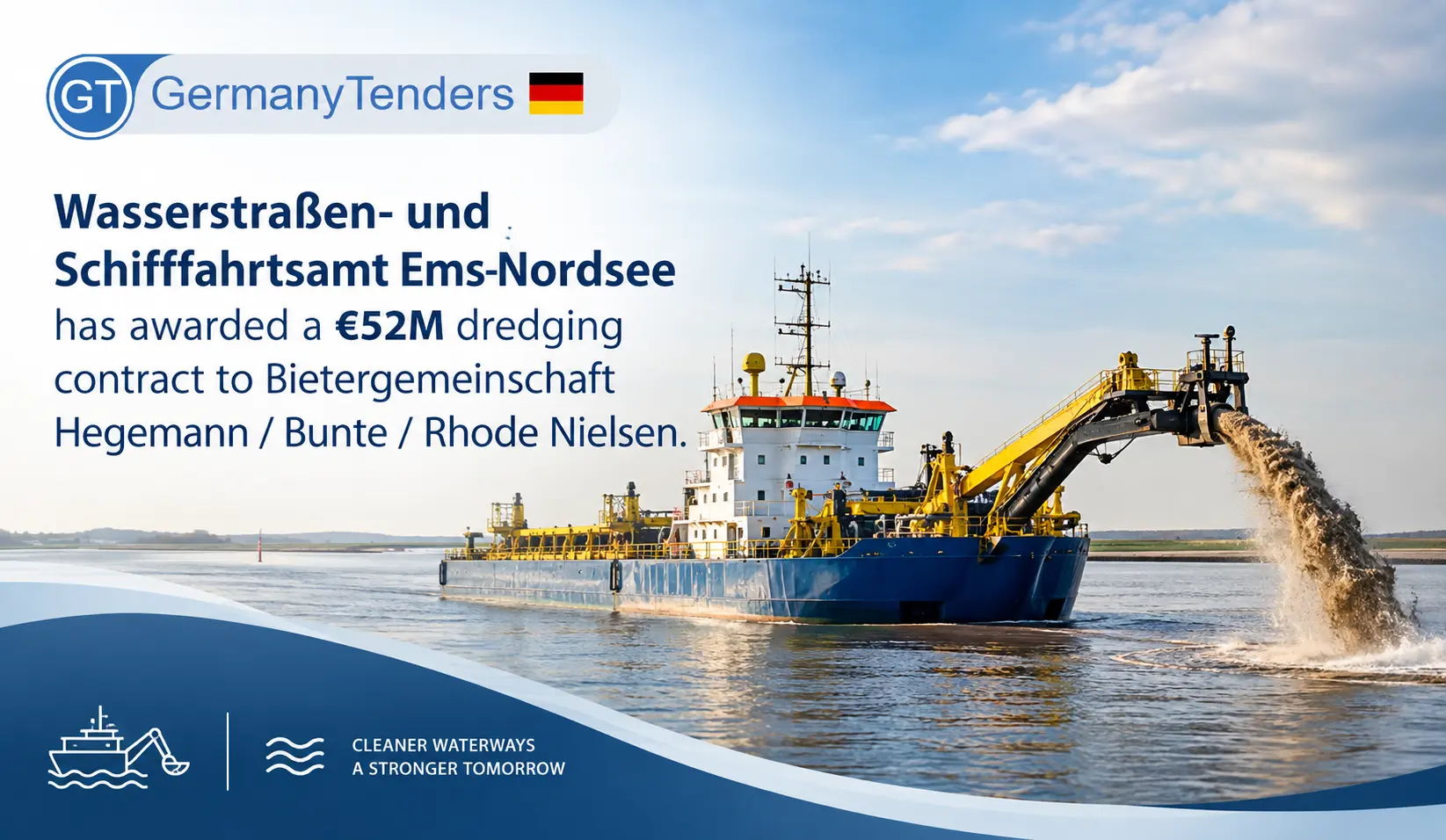
Wasserstraßen- und Schifffahrtsamt Ems-Nordsee has awarded a €52M dredging contract to Bietergemeinschaft Hegemann / Bunte / Rhode Nielsen.
14 Sep 2026
Wasserstraßen- und Schifffahrtsamt Ems-Nordsee, a central government authority responsible for general public services, has awarded a contract for maintenance dredging of the Unterems and Leda fairways (Nassbaggerarbeiten zur Unterhaltung des Fahrwassers der Unterems und Leda 2026-2028) to Bietergemeinschaft Hegemann / Bunte / Rhode Nielsen. The awarded value of the contract is €52,097,717.00, covering dredging, transport, and relocation of approximately 3.5 million m³ of soil volume, with a large proportion to be flushed to land-based disposal areas. The contract was awarded following an open procedure under the standard regime, governed by EU Directive 2014/24/EU. Introduction Wasserstraßen- und Schifffahrtsamt Ems-Nordsee, a central government authority, has conducted an open procedure for maintenance dredging works on the federal waterway Ems and the Leda. The works cover the Unterems from km 0.0 to 40.7 and the Leda from km 22.9 to 24.85. The total service includes dredging, transport, and relocation of approximately 3.5 million m³ of soil volume (survey measurement). Approximately 3.0 million m³ is to be flushed to land-based disposal areas, while approximately 0.6 million m³ is to be dumped at disposal areas in the Ems estuary. The contract was conducted under the standard regime, governed by EU Directive 2014/24/EU. The estimated duration is 25 months, with an optional extension of 6 months under § 22 EU Abs. 2 Nr. 1 VOB/A-EU. The procurement is not financed with EU funds but is covered by the Government Procurement Agreement (GPA). No strategic procurement objectives were specified. Why This Contract Matters This contract ensures that the Unterems and Leda fairways are maintained at the required depths and widths for safe navigation, particularly for the transfer of new shipyard builds from Papenburg to Emden. This contract matters because it: Supports Waterway Infrastructure: Maintains federal waterway depths and widths Significant Value: €52,097,717.00 awarded value Long-Term Commitment: 25 months, with optional 6-month extension Large Volume: Approximately 3.5 million m³ of dredged material Price Focus: 100% price-based evaluation Competition: 3 tenders received Critical for Ship Transfers: Enables transfer of shipyard new builds Contract Timeline Contract concluded: 06 July 2026 Estimated start date: 01 October 2026 Initial duration: 19 months Maximum renewals: 1 (6 months) Maximum total duration: 25 months (ending 31 October 2028) Notice published: 14 September 2026 (OJ S 177/2026) Notice dispatch date: 11 September 2026 Contract Overview Wasserstraßen- und Schifffahrtsamt Ems-Nordsee conducted an open procedure under the standard regime, governed by EU Directive 2014/24/EU. Key features include: One lot: LOT-0000 Awarded value: €52,097,717.00 Initial duration: 19 months Maximum renewals: 1 (6 months) Maximum total duration: 25 months Framework type: No framework agreement Evaluation: Price (100%) Winner: Bietergemeinschaft Hegemann / Bunte / Rhode Nielsen (large enterprise) Subcontracting: No No EU funding Covered by GPA: Yes Strategic procurement: No strategic procurement Key Contract Details Main classification: 45240000 Construction work for water projects Additional classification: 45247100 Construction work for waterways Place of performance: Bundeswasserstraße Ems, Ems-km 0.0 to Ems-km 40.7 and Leda-km 22.9 to Leda-km 24.85; Emden, Germany (NUTS: DE942) Procedure identifier: f1af1054-d6ad-4f5e-a872-579a79e3032e Internal identifier: 2026-801-000002 Type of procedure: Open Accelerated procedure: No Legal basis: Directive 2014/24/EU; VgV - § 3 EU Nr. 1 VOB/A open procedure Review body: Bundeskartellamt Review deadline: Per § 160 (3) No. 1-4 GWB Lot Structure Lot 1 – Dredging Works Unterems and Leda Title: Nassbaggerarbeiten zur Unterhaltung des Fahrwassers der Unterems und Leda 2026-2028 Description: Dredging works (trailing suction hopper dredger) to maintain and restore required target depths and widths in the fairway in the tidal area of the Unterems from km 0.0 to 40.7 and the Leda from km 22.8 to 24.85 Awarded value: €52,097,717.00 Winner: Bietergemeinschaft Hegemann / Bunte / Rhode Nielsen Tenders received: 3 Contract concluded: 06 July 2026 Duration: 19 months initial, with optional 6-month extension Lot Summary Table Lot Title Value (€) Winner Tenders 1 Dredging Works Unterems and Leda 52,097,717.00 Bietergemeinschaft Hegemann / Bunte / Rhode Nielsen 3 Total 52,097,717.00 Scope of Supply The contract covers the following works: Dredging: Dredging works using trailing suction hopper dredger to maintain and restore required target depths and widths Transport: Transport of dredged material Relocation: Relocation of approximately 3.5 million m³ of soil volume Land Disposal: Flushing of approximately 3.0 million m³ to land-based disposal areas Estuary Disposal: Dumping of approximately 0.6 million m³ at disposal areas in the Ems estuary Dredging Campaigns: Execution in so-called dredging campaigns for transfer of shipyard new builds Leda Dredging: Individual dredging of approximately 30,000 m³ each in the Leda before and after campaigns Optional Shuten Use: Shuten use tendered as a need position Special Procurement Conditions Dredging Campaigns: Execution in campaigns linked to shipyard transfer dates (S724: 21.03.2027; S723: 18.09.2027; S725: 13.02.2028) Campaign Timing: A campaign may begin no earlier than 15 weeks before a ship transfer Campaign 2027-1: Early December 2026 to mid-March 2027; volume approximately 1,053,750 m³ Campaign 2027-2: Mid-June 2027 to mid-September 2027; volume approximately 1,338,750 m³ Campaign 2028-1: Early November 2027 to mid-February 2028; volume approximately 1,053,750 m³ Leda Dredging: Total approximately 120,000 m³ Extension Option: Optional 6-month extension under § 22 EU Abs. 2 Nr. 1 VOB/A-EU Extension Campaign: Campaign 2028-2 from mid-June 2028 to 15.09.2028 for transfer of shipyard new build S722 on 17.09.2028; volume approximately 1.3 million m³ Extension Leda: Approximately 60,000 m³ E-Procurement: Requests and submissions only via the federal e-procurement platform Soil Composition: Approximately 90% silt; remainder sand; consistency mostly "pulpy" to "soft" About the Contracting Authority Wasserstraßen- und Schifffahrtsamt Ems-Nordsee is a central government authority responsible for general public services, specifically waterway and navigation administration. Legal type: Central government authority Activity: General public services Registration number: 991-00601-94 Location: Emden, Germany (NUTS: DE942) Address: Am Eisenbahndock 3, 26725 Emden Contact: Servicestelle für Vergabe Email: Vergabestelle.wsa-ems-nordsee@wsv.bund.de Telephone: +49 4921 8020 Fax: +49 4921 802379 Internet address: https://www.wsa-ems-nordsee.wsv.de/ About the Winning Supplier Bietergemeinschaft Hegemann / Bunte / Rhode Nielsen is a large enterprise bidding consortium based in Bremen, Germany, specialising in dredging and waterway construction works. Size: Large enterprise Registration number: UStID. DE 174007131 Location: Bremen, Germany (NUTS: DE501) Address: Arberger Hafendamm 16, 28309 Bremen Subcontracting: No Evaluation Criteria The lot uses the following evaluation criterion: Price (100%): 100% price-based evaluation Procurement Analysis Procedure: Open procedure under the standard regime, governed by EU Directive 2014/24/EU Competition: 3 tenders received Subcontracting: No subcontracting declared No EU funding: The procurement was not financed with EU funds No framework agreement: No framework agreement No dynamic purchasing system used Accelerated procedure: No Strategic procurement: No strategic procurement Review body: Bundeskartellamt Call for competition terminated: The call for competition has been terminated (contract awarded) Additional Procurement Facts The contract is covered by the WTO's Government Procurement Agreement (GPA) No EU funds were used for this procurement The awarded value is €52,097,717.00 The procurement is divided into one lot Price (100%) is the evaluation criterion Three tenders were received The winner is a large enterprise No subcontracting was declared The contract duration is 19 months, with optional 6-month extension (maximum 25 months) Approximately 3.5 million m³ of soil volume to be dredged Self-employed persons noted in additional information Market & Industry Perspective The German public sector waterway construction market features specialised dredging contractors. Maintenance dredging is essential for keeping federal waterways navigable, particularly for the transfer of large shipyard new builds. Key trends in this market include: Price focus: 100% price-based evaluation Specialised providers: Dominance of large dredging companies Campaign-based works: Dredging tied to ship transfer schedules Long-term contracts: Up to 25 months with extension Environmental considerations: Land-based disposal and estuary dumping Federal procurement: Central government authority tendering Economic Significance At €52,097,717.00, this contract represents a significant investment in waterway maintenance for the Unterems and Leda. The contract will: Support Waterway Infrastructure: Maintain required depths and widths for navigation Support Large Enterprise: Bietergemeinschaft Hegemann / Bunte / Rhode Nielsen is a large consortium Provide Long-Term Stability: Up to 25-month contract Ensure Navigation Safety: Enables safe transfer of shipyard new builds Enable Operational Efficiency: Campaign-based dredging aligned with ship transfers Support Shipbuilding: Critical for Papenburg to Emden transfers Future Procurement Opportunities With this contract now in place, future opportunities include: Re-tender: Expected after the 25-month maximum duration Related Works: Additional waterway maintenance and construction works Subcontracting: Potential opportunities with the winning consortium Other Waterway Projects: Similar dredging procurement opportunities Extension: Optional 6-month extension may create further opportunities Opportunities for Suppliers While this contract is awarded, opportunities remain for waterway construction suppliers: Re-tender: Prepare for the next procurement cycle Subcontracting: Potential opportunities with the winning consortium Related Works: Other waterway maintenance and construction works Other German Waterway Authorities: Similar dredging procurements Extension Period: Monitor extension campaign opportunities What Businesses Should Watch Wasserstraßen- und Schifffahrtsamt Ems-Nordsee's future procurement notices Other German waterway maintenance tenders Dredging services market trends Changes to German procurement regulations Shipyard transfer schedules affecting dredging campaigns GermanyTenders Procurement Intelligence This dredging contract is a notable example of German public sector waterway procurement. Several features stand out: Scale: €52.1M over 25 months Price focus: 100% price-based evaluation Large winner: Bietergemeinschaft Hegemann / Bunte / Rhode Nielsen One lot: Dredging works Unterems and Leda Campaign-based: Works tied to shipyard transfer schedules Competition: 3 tenders received Large volume: Approximately 3.5 million m³ For suppliers, this procurement highlights the importance of: Competitive pricing: 100% price-based evaluation Dredging capability: Ability to deploy trailing suction hopper dredgers Campaign scheduling: Ability to meet tight ship transfer deadlines Public sector experience: Understanding of German waterway requirements Scale capability: Ability to handle large dredging volumes Supplier Takeaways Offer competitive pricing – 100% of evaluation is price-based Demonstrate dredging capability with trailing suction hopper dredgers Show ability to meet campaign schedules tied to ship transfers Develop public sector experience with German waterway authorities Demonstrate scale capability for large dredging volumes Monitor WSA Ems-Nordsee and German waterway procurement opportunities Key Takeaways Wasserstraßen- und Schifffahrtsamt Ems-Nordsee awarded a €52,097,717.00 dredging contract to Bietergemeinschaft Hegemann / Bunte / Rhode Nielsen One lot: Dredging works Unterems and Leda 2026-2028 Duration: 19 months initial, with optional 6-month extension (maximum 25 months) Evaluation: Price (100%) 3 tenders received Winner is a large enterprise No subcontracting declared No EU funding Covered by GPA: Yes Approximately 3.5 million m³ of soil volume to be dredged Campaign-based works tied to shipyard transfer schedules Conclusion This dredging contract ensures that the Unterems and Leda fairways are maintained at the required depths and widths for safe navigation, particularly for the transfer of shipyard new builds from Papenburg to Emden. By awarding the contract to Bietergemeinschaft Hegemann / Bunte / Rhode Nielsen, WSA Ems-Nordsee secures a reliable supplier with the scale and capability to deliver large-scale dredging works. The 100% price-based evaluation reflects the commoditised nature of dredging procurement, where price is the primary differentiator among qualified suppliers. The campaign-based execution and the optional extension reflect the complexities of waterway maintenance aligned with shipyard schedules. For suppliers, this procurement highlights the importance of competitive pricing, dredging capability, campaign scheduling, public sector experience, and scale capability in winning German public sector waterway contracts. Frequently Asked Questions Q: What is Wasserstraßen- und Schifffahrtsamt Ems-Nordsee? Ans: A central government authority responsible for general public services, specifically waterway and navigation administration in the Ems-Nordsee region. Q: What is the value of the contract? Ans: Awarded value €52,097,717.00. Q: Who is the winner? Ans: Bietergemeinschaft Hegemann / Bunte / Rhode Nielsen, a large enterprise bidding consortium based in Bremen, Germany. Q: What works are covered? Ans: Dredging works (trailing suction hopper dredger) to maintain and restore required target depths and widths in the Unterems and Leda fairways. Q: What were the evaluation criteria? Ans: Price (100%). Q: How long is the contract? Ans: 19 months initial, with an optional 6-month extension (maximum 25 months). Q: How many tenders were received? Ans: Three tenders. Q: Is this contract funded by the EU? Ans: No, the procurement is not financed with EU funds. Q: What is the review body? Ans: Bundeskartellamt. Q: What is the lot structure? Ans: One lot – LOT-0000 (Nassbaggerarbeiten zur Unterhaltung des Fahrwassers der Unterems und Leda 2026-2028). Q: Is the procurement contingent on anything? Ans: The works are executed in dredging campaigns tied to shipyard new build transfer dates; an optional 6-month extension may be exercised under § 22 EU Abs. 2 Nr. 1 VOB/A-EU. Q: Is subcontracting allowed? Ans: No subcontracting was declared by the winner. Q: What is the soil composition? Ans: Approximately 90% silt and the remainder sand; consistency mostly "pulpy" to "soft". Q: What is the total dredging volume? Ans: Approximately 3.5 million m³ of soil volume, with approximately 3.0 million m³ flushed to land-based disposal areas and approximately 0.6 million m³ dumped at estuary disposal areas. Source: EU Official Journal, Contract Award Notice 632782-2026, OJ S 177/2026, published 14 September 2026. ```
View Details