Dresden Locks In a €56 Million Consortium to Rebuild Its Königsbrücker Straße Tram and Road Corridor
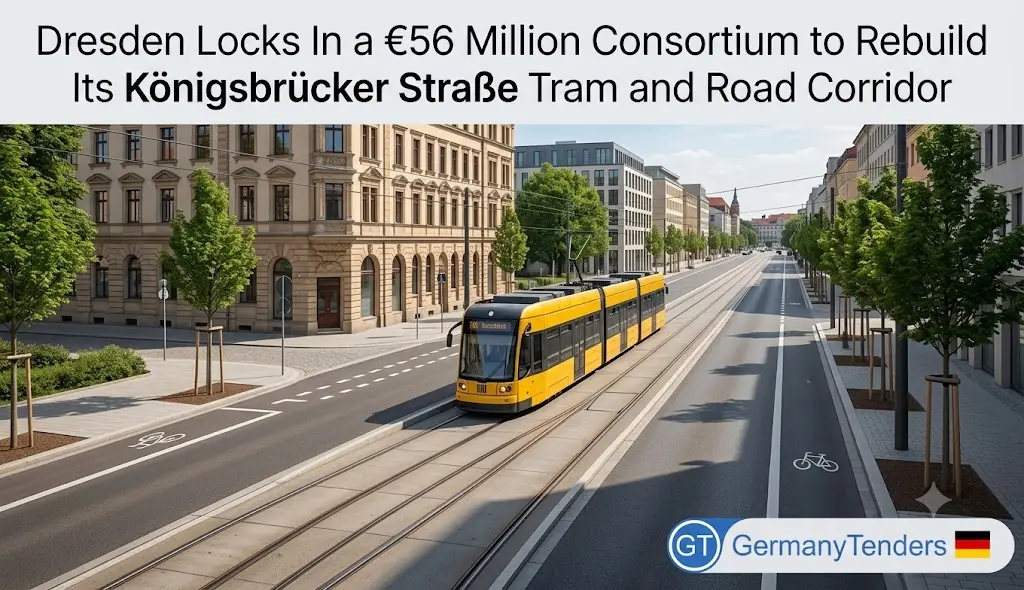
A public buying group led by the City of Dresden has awarded a four-year works contract worth almost €56 million to rebuild one of the city's key tram and road arteries between Albertplatz and Stauffenbergallee. The winning bid, submitted by a construction consortium of EUROVIA, Wolff & Müller and STRABAG, covers everything from tram track and street rebuilding to sewers, a new tram power substation, and utility works for five separate infrastructure operators.
Introduction
Königsbrücker Straße is one of
Dresden's principal north–south corridors, carrying tram lines, road traffic,
cyclists and pedestrians through the city's Neustadt district. Rebuilding a
stretch of that scale means far more than resurfacing a road: tram tracks,
sewers, drinking water, gas, district heating, telecoms and power
infrastructure all sit beneath or alongside the carriageway, and all of it ages
at different rates.
A joint buying group
representing the city's road authority, its wastewater utility, its transport
operator and three separate utility companies has now awarded the first major
works package for that rebuild. The contract, covering the southern section of
Königsbrücker Straße between Albertplatz and Stauffenbergallee, went to a
three-firm construction consortium for just under €56 million.
Why This Contract Matters
Large urban infrastructure
renewals rarely involve a single buyer. This procurement is a case study in how
German cities coordinate simultaneous works among a road authority, a sewage
utility, a transit operator and multiple private utility companies, so that a
street is dug up once rather than repeatedly over several years.
For the construction sector, it
also illustrates how the largest urban infrastructure jobs increasingly go to
multi-firm consortia rather than single contractors, spreading both the
technical scope, tram engineering, deep drainage, road building, and the
financial risk of a multi-year, nine-figure commitment across several balance
sheets.
Contract Timeline
•
Internal reference: 2025-66-00039
•
Notice published: 9 July 2026 (OJ S 130/2026)
•
Contract concluded: 1 July 2026
•
Works start date: 7 September 2026
•
Estimated completion:
5 April 2030
Contract Overview
The contracting side is a joint
buying group ("AGG") made up of the City of Dresden's Straßen- und
Tiefbauamt (road and civil engineering authority), the municipal wastewater
utility Stadtentwässerung Dresden GmbH, transit operator Dresdner
Verkehrsbetriebe AG, and three utility companies acting through
representatives: Vodafone Deutschland GmbH, Telekom Deutschland GmbH (via
Deutsche Telekom Technik GmbH) and DREWAG Stadtwerke Dresden GmbH (via
SachsenEnergieBau GmbH).
The buying group ran an open
procedure under German public works procurement rules (VOB/A-EU) and received
two tenders, both submitted electronically. One came from a tenderer classed as
a micro, small or medium enterprise. The contract was awarded purely on price,
and the group signed with the winning bidder on 1 July 2026.
Key Contract Details
|
Detail |
Information |
|
Contracting authority |
AGG Dresden: Straßen- u.
Tiefbauamt, Stadtentwässerung Dresden GmbH, Dresdner Verkehrsbetriebe AG,
Vodafone Deutschland GmbH, Telekom Deutschland GmbH and DREWAG Stadtwerke
Dresden GmbH |
|
Winning bidder |
BiGe EUROVIA VB GmbH, NL
Dresden / Wolff & Müller / STRABAG AG (consortium) |
|
Contract subject |
Road, tram-track and civil
engineering works, CPV 45233120, plus pipeline, sewer, telecom and tramline
construction works |
|
Procedure type |
Open procedure |
|
Legal basis |
EU Directive 2014/24/EU;
German VOB/A-EU |
|
Estimated value (ex-VAT) |
€60,005,403.16 |
|
Value of contract awarded |
€55,985,519.88 |
|
Contract duration |
7 September 2026 – 5 April
2030 (approx. 3.5 years) |
|
Tenders received |
2 (both submitted
electronically; 1 from an SME) |
|
EU funding |
None disclosed |
|
Covered by GPA |
Yes |
|
Contract signed |
1 July 2026 |
Project Scope
The works are split across
several strands of infrastructure. On the tram and road side, the contract
covers new asphalt, mastic asphalt and concrete surfacing across tens of
thousands of square metres, alongside new tram track: fixed-slab track, frame
track, sleeper track, a level crossing, points, and grooved-rail sections, plus
eight tram stops fitted with combi kerbs. Granite paving, granite crust slabs
and natural-stone setts feature heavily, reflecting Dresden's traditional streetscape
treatment, alongside kerbstones and gutters.
A separate strand covers a new
rectifier substation ("Gleichrichterunterwerk") for the tram traction
power supply, including bored pile retaining walls, sheet-pile bracing, a large
excavation, waterproof concrete floor slabs, walls and ceiling slabs, and
calcium-silicate masonry.
Underground works are
extensive: demolition of old shafts, structures and sewer runs; tens of
thousands of cubic metres of excavation; new sewer pipes ranging from DN 300 up
to DN 1300 in concrete, GRP and PVC-U; new connection sewers; new manholes up
to DN 2500; and four special structures. On top of this sits utility work for
street lighting, traffic signal systems, tram overhead power, telecoms conduit
for Deutsche Telekom and Vodafone, and drinking water, gas and district heating
infrastructure for the municipal energy utility.
About the Contracting
Authority
The lead buyer is the City of
Dresden's road and civil engineering office, acting on behalf of a joint buying
group of public and utility bodies. This structure, common in German municipal
infrastructure projects, lets a single procurement and construction programme
serve multiple asset owners at once, coordinating disruption to residents and
businesses along the corridor rather than running five separate sets of
roadworks over several years.
About the Winning Company
The winning bid came from a
construction consortium, or "Bietergemeinschaft", combining EUROVIA's
Dresden branch, Wolff & Müller and STRABAG AG. All three are established
names in German civil engineering and road construction, and the consortium
structure reflects the scale and technical breadth of the project, spanning
tram engineering, deep drainage and structural concrete work, that would be
difficult for a single firm to resource alone. The lead entity is registered in
Radeberg, near Dresden, and is classified as a large enterprise. No
subcontracting was declared.
Procurement Analysis
Procedure: An open procedure was used, allowing any qualified
contractor to submit a tender directly, without a separate pre-qualification
stage.
Competition: Only two tenders were received, a relatively narrow
field for a contract of this value, reflecting how few construction groupings
in the region have the combined tram, drainage and structural engineering
capacity the project demands.
Award criteria: Price was the sole award criterion, weighted at 100
percent, meaning the contract went to the lowest compliant bid rather than
being scored on technical or quality factors.
Value gap: The winning bid of just under €56 million came in
roughly 7 percent below the buying group's own estimate of €60 million, a
modest but notable margin for a project of this complexity.
GPA status: The contract falls under the WTO's Government
Procurement Agreement, meaning it was in principle open to qualifying
international bidders, though the winning consortium is entirely German.
Additional Procurement Facts
•The procedure was not
accelerated, indicating a standard timeline was followed.
•No framework agreement
or dynamic purchasing system was used; this is a single, direct works contract.
•All communication in the
procedure, including bidder queries and post-award correspondence, was required
to run through the eVergabe.de electronic platform.
•Disputes or review
requests fall to the 1st Chamber for Public Procurement (Vergabekammer) of the
Free State of Saxony, based in Leipzig.
•Neither tender came from
a bidder registered elsewhere in the European Economic Area or beyond it; both
received tenders were domestic.
Market & Industry
Perspective
Large German cities are in the
middle of a sustained cycle of tram and road-network renewal, much of it
involving infrastructure originally built decades ago and now reaching the end
of its service life. Coordinating that renewal with parallel utility upgrades,
as this contract does, has become the standard model for minimising repeated
disruption to the same stretch of street.
For contractors, that model
rewards firms, or consortia of firms, able to combine tram-specific engineering
with conventional road building and deep drainage work, since single-discipline
specialists are rarely equipped to bid competitively alone on projects of this
scale.
Economic Significance
At just under €56 million, this
is a substantial single works contract even by the standards of major German
infrastructure programmes, and it will keep a large multi-disciplinary
workforce engaged on one corridor for close to four years. Beyond the immediate
construction spend, the project underpins the reliability of a tram line and
utility network that residents, businesses and public services along the
corridor depend on daily.
The multi-year, price-led
contract also gives the winning consortium revenue certainty through to 2030,
while committing the buying group to a fixed cost for a project whose
underlying scope, spanning five separate infrastructure disciplines, would
otherwise be difficult to budget for with confidence.
Future Procurement
Opportunities
Königsbrücker Straße's renewal
is described in the notice as covering the southern section between Albertplatz
and Stauffenbergallee, suggesting further sections or related packages may
follow as Dresden continues its broader tram and road modernisation programme.
Utility companies and contractors active in Saxony should expect comparable
coordinated-works tenders as the city works through its ageing infrastructure
inventory.
Opportunities for Suppliers
The scale and technical breadth
of this contract, tram track, structural concrete, sewer construction and
multi-utility coordination, means subcontracting opportunities are likely to
open up across the works programme even though the prime consortium declared
none at award. Specialist suppliers in rail engineering, natural-stone paving
and underground utility works are the segments most directly relevant to the
scope described.
What Businesses Should Watch
•Whether Dresden issues
further works packages for adjoining sections of Königsbrücker Straße or
comparable tram corridors.
•How the consortium
structures subcontracting as the four-year programme progresses, despite
declaring none at award.
•Price-only award
criteria on large works contracts, which reward the lowest compliant bid over
technical differentiation.
TendersOnTime Procurement
Intelligence
This contract shows how German
cities manage a structural challenge shared by ageing urban infrastructure
everywhere: a street cannot be rebuilt piecemeal, discipline by discipline,
without disproportionate cost and disruption. Bringing five separate asset
owners, road authority, sewage utility, transit operator and two utility
groups, into a single joint procurement solves that by forcing coordinated
design and a single construction window.
The more interesting signal is
the award structure itself. With price as the sole criterion, the buying group
prioritised cost certainty over technical differentiation, a rational choice
for a well-specified works contract where the engineering requirements, tram
gauge, sewer diameters, materials, are already fixed in detail rather than open
to competing technical approaches.
For contractors, the lesson is
that competing successfully on projects of this scale increasingly means
forming a consortium capable of covering multiple engineering disciplines at
once, rather than bidding as a specialist in any single one.
Supplier Takeaways
• Coordinated
multi-utility works contracts of this kind are becoming the standard model for
major German street renewals, worth tracking for pipeline visibility.
• Price-only award
criteria mean competitive cost control, not technical differentiation, is what
wins contracts like this one.
•Multi-firm consortium
bidding, as seen here, appears to be the preferred structure for the largest,
most technically complex urban infrastructure jobs.
• Coordinated works
spanning tram, road, sewer and utility disciplines offer long-term
subcontracting potential even where none is declared at award.
Key Takeaways
• A Dresden-led buying
group awarded a €55.99 million works contract to rebuild Königsbrücker Straße's
tram and road corridor to a EUROVIA/Wolff & Müller/STRABAG consortium.
•The contract runs for
roughly three and a half years, from September 2026 to April 2030.
•Two bids were received
through an open procedure decided entirely on price.
•The project coordinates
work for five separate infrastructure bodies, spanning tram track, roads,
sewers, a new substation and multiple utilities.
•The winning bid came in
about 7 percent below the buying group's own cost estimate.
Conclusion
This is a large, technically
dense infrastructure contract that will not make national headlines, but it
reflects how German cities are tackling ageing urban infrastructure: by
coordinating multiple asset owners into a single procurement rather than
digging up the same street repeatedly. The EUROVIA/Wolff & Müller/STRABAG
consortium now carries responsibility for delivering that renewal on one of
Dresden's key transit corridors through to 2030.
Frequently Asked Questions
Q1. What is an AGG in this context?
It refers to an
"Arbeitsgemeinschaft" or joint buying group, here formed by Dresden's
road authority together with a wastewater utility, a transit operator, and
three utility companies, so that a single works contract covers all their
infrastructure needs along one street.
Q2. Why does the project include a tram substation?
The Königsbrücker
Straße corridor carries tram lines, and the works include building a new
rectifier substation to supply traction power to the tram network alongside the
track and road renewal.
Q3. Why was price the only award criterion?
For a works contract with
a fully specified technical scope, price-only evaluation lets the buying group
select the lowest-cost compliant bid without scoring competing technical
approaches.
Q4. Is this contract funded by the EU?
No. The notice confirms the
project is not financed with EU funds, though it is governed by EU Directive
2014/24/EU and covered by the WTO's Government Procurement Agreement.
Q5. Did any subcontracting take place?
No subcontracting was declared
by the winning consortium at the time of award.

Fresh and verified Tenders from Germany. Find, search and filter Tenders/Call for bids/RFIs/RFPs/RFQs/Auctions published by the government, public sector undertakings (PSUs) and private entities.
- 1,000+ Tenders
- Verified Tenders Only
- New Tenders Every Day
- Tenders Result Data
- Archive & Historical Tenders Access
- Consultants for RFI/RFP/RFQ
- Tender Notifications & Alerts
- Search, Sort, and Filter Tenders
- Bidding Assistance & Consulting
- Customer Support
- Publish your Tenders
- Export data to Excel
- API for Tender Data
- Tender Documents

Fill out the form below and you will receive a call from us within 24 hours.
Get FREE SAMPLE TENDERS from Germany in your email inbox.
Copyright © 2014-2026 GermanyTenders.com. All Rights Reserved.