Berlin Locks In a €42 Million Deal to Modernise the Software Running Its Federal Bureaucracy
Introduction
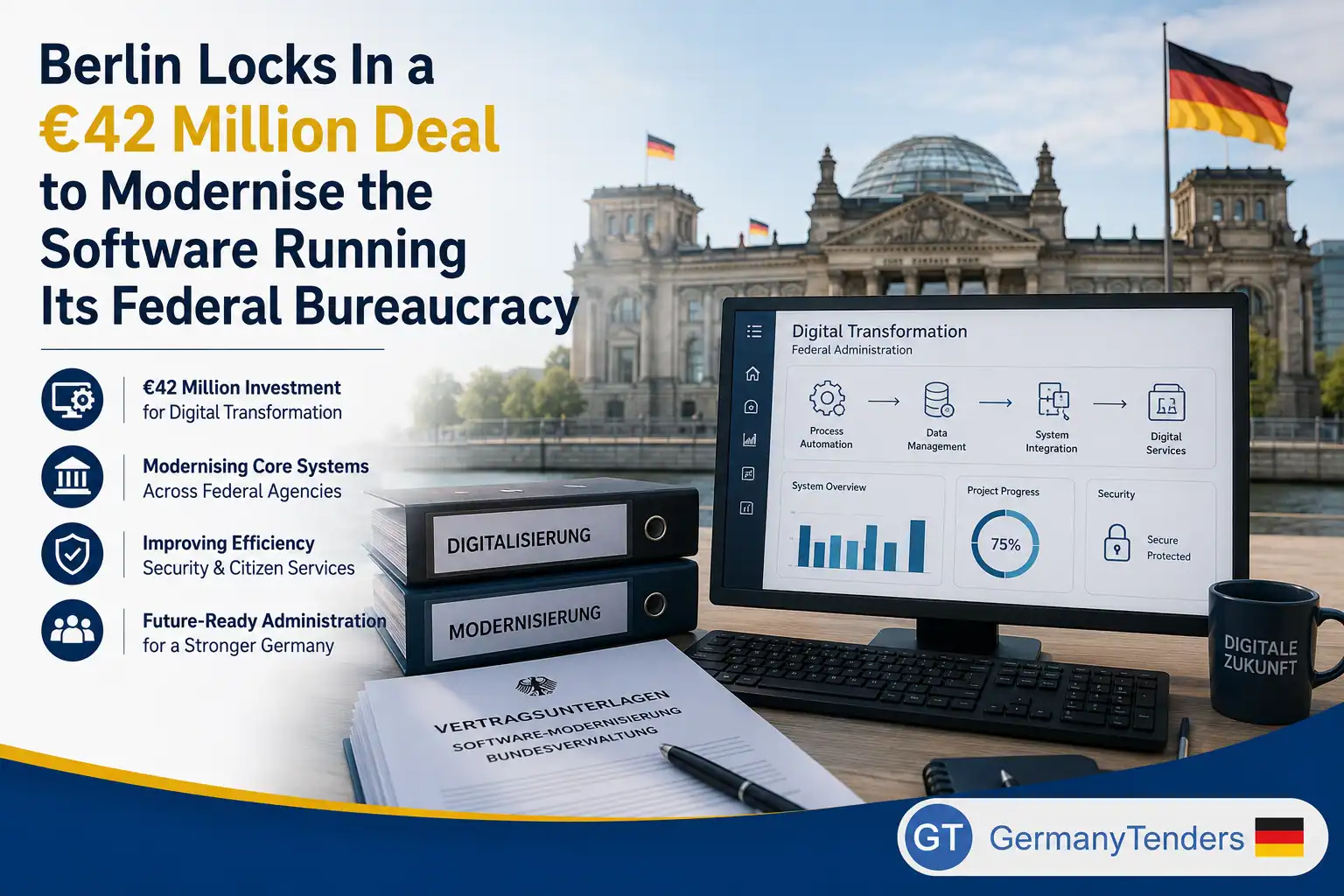
Behind every visa processed, benefit approved or federal record updated in Germany sits a piece of software nobody outside government ever sees. Keeping those systems running and building new ones, is a permanent, unglamorous task. Berlin has just handed a significant slice of that task to SEITENBAU, a medium-sized software company from Lake Constance, under a framework agreement that could run as long as six years and be worth up to €42 million.
The contract covers "Fachverfahren", a German term for specialist administrative software, the systems that manage day to day casework inside federal authorities rather than the more generic office IT most people picture.
Why This Contract Matters
Federal governments run on custom software: benefits administration, registry systems, casework tools, none of which come off the shelf. This contract is one of five lots in a broader framework designed to give Germany's Federal Office of Administration (Bundesverwaltungsamt) ongoing access to the developers who build and maintain that software.
For industry, it is a signal that Berlin is willing to commit multi year, high value framework spending to mid-sized specialist firms rather than only the largest systems integrators, a meaningful opening for companies with the right technical niche.
Contract Timeline
- Procedure launched: Prior notice referenced under procedure identifier 6748ca3f-7391-4dc5-b00a-0e313cb433c9
- Contract concluded: 9 June 2026
- Notice published: 7 July 2026 (OJ S 128/2026)
- Framework duration: Up to 72 months (6 years), running from contract signature until the framework's maximum value is exhausted or 48 months as a base term, extendable twice by 12 months each
Contract Overview
The buyer is the Beschaffungsamt des BMI, the German Federal Ministry of the Interior and for Community's central procurement office, acting on behalf of the Bundesverwaltungsamt, the federal administrative authority that will actually use the software. The tender was run as an open procedure, meaning any qualified company could bid without a pre-selection stage and it drew four tenders, two of them from small or medium-sized firms.
This is Lot 5 of a broader five-lot framework covering IT services in support of federal administrative tasks. The contracting authority has not disclosed details of the other four lots in this notice.
Key Contract Details
| Detail | Information |
|---|---|
| Contracting authority | Beschaffungsamt des BMI, on behalf of Bundesverwaltungsamt |
| Winning bidder | SEITENBAU (Konstanz, Germany) |
| Contract subject | Development and maintenance of specialist administrative software (Lot 5 of 5) |
| CPV code | 72000000 – IT services: consulting, software development, Internet and support |
| Procedure type | Open procedure |
| Legal basis | Directive 2014/24/EU |
| Maximum framework value | €42,016,806.72 |
| Contract duration | Up to 72 months |
| Tenders received | 4 (2 from SMEs; 1 from another EEA country; 0 from outside the EEA) |
| Award criteria | Quality (50%) and Price (50%) |
| EU funding | Partially funded, see below |
| Covered by GPA | Yes |
| Framework type | Without reopening of competition |
| Contract signed | 9 June 2026 |
Project Scope
The contract funds ongoing development and upkeep of "Fachverfahren", specialist software applications that support specific casework functions inside federal authorities, as distinct from general-purpose IT infrastructure. Work will primarily be based out of Cologne, the operational home of the Bundesverwaltungsamt, though the notice specifies that deliveries and on-site work may also be required in Hamm, Berlin or other locations, including at the Interior Ministry itself, when specific tasks demand it.
Notably, the notice states that the contractor will generally not develop the software on the client's own premises or infrastructure, an indication that SEITENBAU will build much of the system remotely, on its own technical environment, before deployment.
The framework's duration is unusually structured: it runs until either the maximum contract value is exhausted or 48 months pass, whichever comes first, with two possible 12-month extensions at the buyer's discretion, capping the total possible term at 72 months.
About the Contracting Authority
The Beschaffungsamt des BMI is the central procurement body for Germany's Federal Ministry of the Interior and for Community, handling large-scale IT and services purchasing on behalf of federal agencies. In this case it procured on behalf of the Bundesverwaltungsamt, the Federal Office of Administration, which handles a wide range of administrative functions for the German federal government and will be the actual end-user of the software built under this contract.
About the Winning Company
SEITENBAU is a medium-sized German software company based in Konstanz, on Lake Constance, close to the Swiss border. The contracting authority has not disclosed further detail on the company's specific technical specialisms beyond its role as the lot's sole confirmed winner.
Procurement Analysis
Procedure: An open procedure was used, the most transparent and widely accessible route under EU procurement law, allowing any qualified firm to submit a bid directly without a restricted prequalification round.
Competition: Four tenders were received, a healthy field for a specialised federal IT contract. Two came from small or medium-sized firms, one from a tenderer registered elsewhere in the European Economic Area and none from outside the EEA, a pattern consistent with a market where language, legal familiarity and security clearance requirements naturally favour domestic and near-domestic bidders.
Evaluation criteria: The contract was decided on an even split, 50% quality (assessed via a named performance metric, "Leistungskennzahl," under the tender's special application conditions) and 50% price. That balance suggests the buyer wanted strong technical delivery capability without simply defaulting to the cheapest bid.
Framework structure: The agreement was awarded without reopening competition, meaning SEITENBAU will deliver directly under call-off orders for the life of the contract rather than councils or departments re-competing individual assignments.
Foreign Subsidies Regulation: The procedure explicitly falls under the EU's Foreign Subsidy Regulation, meaning bidders had to declare any financial support received from non-EU governments, a relatively new compliance layer aimed at preventing distortion of the EU internal market by subsidised foreign competitors.
GPA status: The contract is covered by the WTO's Government Procurement Agreement, formally opening it to qualifying bidders worldwide, though in practice the field remained entirely European.
Additional Procurement Facts
- The notice confirms this is an EU-funded procurement project, with sub-projects under Lots 2 and 3 of the wider framework currently co-financed through the EU's Internal Security Fund; further funding streams are under ongoing review and could extend to other lots, including this one, in future.
- The contract includes a strategic procurement objective tied to social goals, specifically fair working conditions, with bidders required to submit a self-declaration referencing ILO (International Labour Organization) standards.
- Bidders were required to submit self-declarations confirming no grounds for exclusion under German competition law (§§123, 124 GWB), plus a specific declaration regarding sanctions against Russia.
- The contracting authority noted particular sensitivity around ensuring no confidential information is passed to foreign security authorities, with specific contractual clauses addressing this.
- Procurement documents for this tender were prepared with the assistance of an external law firm, Kremer Legal.
- Disputes fall under the jurisdiction of the Vergabekammer des Bundes (Federal Public Procurement Tribunal) in Bonn; any challenge to the contract's validity must be filed within 30 calendar days of this notice's publication.
Market & Industry Perspective
Federal government software maintenance contracts of this scale are a stable, recurring feature of Germany's public IT market, rewarding firms that can commit to years-long support relationships rather than one-off project delivery. SEITENBAU's win here places a mid sized specialist alongside the country's largest systems integrators as a credible federal supplier, a competitive dynamic increasingly common in EU public IT tenders, where technical fit and security compliance often outweigh sheer company size.
The split five-lot structure of the underlying framework also suggests Berlin deliberately avoided concentrating this work with a single contractor, spreading both risk and opportunity across multiple suppliers.
Economic Significance
At up to €42 million over as long as six years, this is a substantial, long horizon commitment for a mid-sized software firm and it illustrates how EU internal security funding is increasingly blended into everyday national IT procurement rather than being confined to standalone security projects. The partial EU financing of related lots also signals Brussels' growing role in underwriting the digital infrastructure of national administrations, not just cross-border programmes.
Future Procurement Opportunities
With funding streams "continuously under review" for other lots, according to the notice, further EU cofinancing could later extend to this Lot 5 contract or its companion lots. The framework's own extension mechanism, two possible 12-month renewals, means SEITENBAU's relationship with the Bundesverwaltungsamt could continue well past the initial term, offering visibility into a recurring revenue stream through the early 2030s.
Opportunities for Suppliers
IT firms, particularly mid-sized, security-cleared developers, should note that Germany's federal procurement system is actively awarding substantial, multi year framework contracts to companies below systems-integrator scale, provided they can meet quality benchmarks and compliance obligations around foreign subsidy declarations and data confidentiality. The other four lots in this same framework, not detailed in this notice, may represent further live or upcoming opportunities worth investigating directly with the Beschaffungsamt des BMI.
What Businesses Should Watch
- Whether EU Internal Security Fund cofinancing expands to Lot 5 and the framework's remaining lots, as flagged as a possibility in the notice.
- How the Foreign Subsidy Regulation reporting requirement is applied in practice across future German federal IT tenders, since this is a relatively new compliance layer for bidders.
- Whether the framework's extension options are exercised, which would extend SEITENBAU's engagement well beyond the initial four-year base term.
Germanytenders.com Procurement Intelligence
This contract is a clear marker of how the EU's Foreign Subsidy Regulation is now showing up as a standard compliance requirement in mainstream domestic IT procurement, not just in flagship cross-border deals. Bidders competing for German federal contracts must now navigate an additional disclosure layer around foreign state support, a compliance cost that larger, internationally backed competitors may find more burdensome than smaller domestic firms like SEITENBAU.
The second notable pattern is the blending of security-fund financing into routine administrative software contracts. Framing IT modernisation partly as internal security spending reflects a broader EU trend: digital infrastructure, even for unglamorous back office systems, is increasingly treated as a security and resilience issue rather than pure administrative housekeeping.
For suppliers, the strategic lesson is that federal-level IT contracts in Germany are splitting large frameworks into multiple lots rather than awarding single monolithic contracts, a structure that widens the door for firms without the balance sheet of the largest integrators. Companies that can demonstrate both technical delivery quality and clean compliance on subsidy and confidentiality declarations are best positioned as similar multi-lot IT frameworks come to market elsewhere in the EU.
Supplier Takeaways
- Federal IT frameworks split across multiple lots create openings for mid-sized specialists, not just the largest systems integrators.
- The Foreign Subsidy Regulation is now a live compliance requirement in domestic EU tenders, firms with non EU financial backing should prepare disclosure documentation early.
- Quality-price splits weighted evenly (50/50) reward technical differentiation, not just cost competitiveness.
- Security and confidentiality clauses, particularly around foreign authority access to data, are increasingly explicit contract terms worth planning for in advance.
- EU security-fund co-financing is expanding into conventional administrative IT contracts, a funding source worth monitoring for future lots.
Key Takeaways
- Germany's Beschaffungsamt des BMI awarded a framework worth up to €42 million to SEITENBAU for specialist administrative software development and maintenance.
- The contract, Lot 5 of a five-lot framework, runs up to 72 months and was concluded on 9 June 2026.
- Four tenders were received under an open procedure, evaluated equally on quality and price.
- The framework is partly EU-funded through the Internal Security Fund, with further funding under review.
- New compliance layers, including the Foreign Subsidy Regulation, applied to this tender.
Conclusion
This contract shows Germany's federal administration continuing to invest steadily in the specialist software that keeps its bureaucracy functioning, while embedding newer EU level compliance and funding mechanisms into what is, at heart, a routine IT maintenance deal. SEITENBAU's win demonstrates that mid-sized domestic firms remain competitive for substantial federal work when they can meet the technical and regulatory bar, a dynamic likely to recur as Berlin renews similar frameworks in the years ahead.
Frequently Asked Questions
Q1: What is a Fachverfahren?
It refers to specialist administrative software used by German public authorities to manage specific casework functions, distinct from general office IT systems.
Q2: Why was the tender split into five lots?
The contracting authority has not disclosed its specific reasoning, though multi-lot structures are commonly used to spread risk across several suppliers and widen competition beyond the largest firms.
Q3: What is the Foreign Subsidy Regulation?
It is an EU rule (Regulation 2022/2560) requiring bidders in public tenders to declare financial support received from non EU governments, aimed at preventing distortion of the EU internal market by subsidised foreign competitors.
Q4: Is this contract funded by the EU?
Partially. Related lots within the same framework are currently cofinanced through the EU's Internal Security Fund and further funding options for other lots, potentially including this one, are under ongoing review.
Q5: How long can the contract run?
Up to 72 months in total: a base period ending either when the framework's maximum value is used up or after 48 months, plus two optional 12-month extensions.

Fresh and verified Tenders from Germany. Find, search and filter Tenders/Call for bids/RFIs/RFPs/RFQs/Auctions published by the government, public sector undertakings (PSUs) and private entities.
- 1,000+ Tenders
- Verified Tenders Only
- New Tenders Every Day
- Tenders Result Data
- Archive & Historical Tenders Access
- Consultants for RFI/RFP/RFQ
- Tender Notifications & Alerts
- Search, Sort, and Filter Tenders
- Bidding Assistance & Consulting
- Customer Support
- Publish your Tenders
- Export data to Excel
- API for Tender Data
- Tender Documents

Fill out the form below and you will receive a call from us within 24 hours.
Get FREE SAMPLE TENDERS from Germany in your email inbox.
Copyright © 2014-2026 GermanyTenders.com. All Rights Reserved.