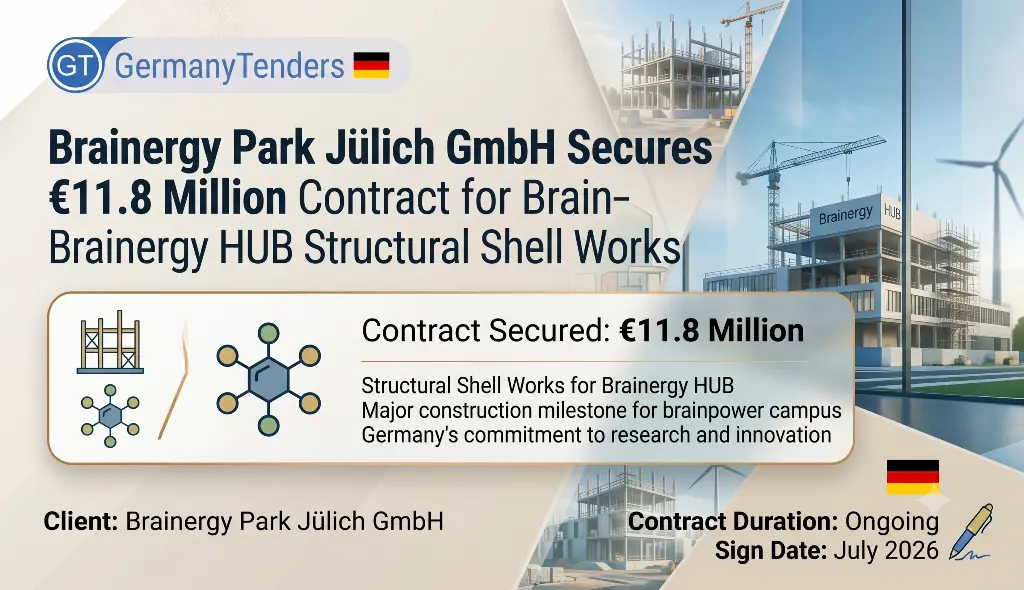
Brainergy Park Jülich GmbH Secures €11.8 Million Contract for Brainergy HUB Structural Shell Works
20 Jul 2026
A contract for structural shell works for the new Brainergy HUB worth €11.8 million has been awarded by Brainergy Park Jülich GmbH. The contract, won by Riedel Bau AG, demonstrates how German innovation parks are developing state-of-the-art facilities to support the energy transition and technology development. Introduction Every groundbreaking research and innovation facility starts with a solid structural shell. The Brainergy HUB in Jülich, North Rhine-Westphalia, is set to become a flagship centre for energy transition research and technology development. Brainergy Park Jülich GmbH has taken a significant step to bring this vision to life by awarding a contract for the structural shell works of the new building. While not a headline-grabbing mega-project, this contract is fundamental to creating the physical infrastructure needed for energy innovation in one of Germany's most important research regions. It reveals a great deal about how German innovation parks are being developed to support the country's Energiewende (energy transition). Why This Contract Matters Jülich is home to one of Germany's most important research centres, Forschungszentrum Jülich, which conducts cutting-edge research in energy, information technology, and biosciences. The Brainergy Park builds on this heritage, creating a hub for companies and research institutions working on energy transition technologies. The Brainergy HUB will provide flexible, modern workspace for start-ups, established companies, and research institutions. The structural shell works are the first major construction phase, creating the building envelope that will house the innovation ecosystem. Contract Timeline Contract award notice published: 20 July 2026 (OJ S 137/2026) Date winner chosen: 8 May 2025 Contract concluded: 19 May 2025 Start date: 19 May 2025 End date: 28 August 2026 Contract Overview Brainergy Park Jülich GmbH conducted an open procedure for structural shell works for the new Brainergy HUB. The contract covers the complete structural shell of the building, including foundations, walls, floors, and roof structure. The total contract value awarded is €11,798,813.52. The contract duration is approximately 15 months, from May 2025 to August 2026. The procurement was conducted under the VOB/A-EU (German Construction Contract Procedures) and follows EU Directive 2014/24/EU. Key Contract Details Detail Information Contracting Authority Brainergy Park Jülich GmbH Winning Bidder Riedel Bau AG Contract Subject Structural shell works (CPV 45223220) Procedure Type Open procedure Legal Basis Directive 2014/24/EU, VOB/A-EU Value of Contract Awarded €11,798,813.52 Contract Duration 19 May 2025 – 28 August 2026 Award Criteria Price (sole criterion) Bids Received 4 EU Funding None disclosed Covered by GPA No Review Organisation Vergabekammer Rheinland Project Scope The contract covers structural shell works (Rohbauarbeiten) for the new Brainergy HUB at Am Brainergy Park 1, Jülich. The scope includes: Foundations: Excavation, foundation works, and ground slabs Structural Framework: Reinforced concrete framework, columns, beams, and load-bearing walls Floor Slabs: Intermediate floor slabs and roof slabs Staircases and Lifts: Structural elements for vertical circulation Roof Structure: Roof construction and waterproofing About the Contracting Authority Brainergy Park Jülich GmbH is a company owned by the city of Jülich and the Düren district, established to develop and operate the Brainergy Park innovation hub. The park is located adjacent to Forschungszentrum Jülich, one of Germany's largest research centres, and is designed to attract companies and research institutions working on energy transition technologies. The park provides modern infrastructure, flexible workspace, and access to a vibrant research ecosystem. About the Winning Company Riedel Bau AG is a large German construction company based in Schweinfurt, Bavaria. The company specializes in structural works, civil engineering, and building construction, with a strong track record in industrial and commercial projects. With decades of experience in delivering complex construction projects, Riedel Bau brings the expertise required for the Brainergy HUB's structural shell works. Procurement Analysis Procedure: An open procedure was used, following the VOB/A-EU (German Construction Contract Procedures). All bids were required to be submitted electronically, with paper bids not accepted. Competition: Four tenders were received, all submitted electronically. This represents a healthy level of competition for a structural shell works contract of this size. Award Criteria: Price was the sole award criterion. This reflects the nature of structural shell works, where technical specifications are clearly defined and quality can be assured through standard construction practices, making price the primary differentiator. GPA Status: The procurement is not covered by the Government Procurement Agreement (GPA), which explains why no international bidders participated. Regulatory Compliance: The contracting authority is responsible for providing information on the general regulatory framework for taxes, environmental protection, and employment protection applicable at the place of performance. Additional Procurement Facts The procurement was conducted exclusively via electronic means, with paper bids not accepted. No subcontracting was used by the winning bidder. The contract is not financed with EU funds. The award was made on the basis of price only. Disputes or review requests fall to the Vergabekammer Rheinland in Cologne. The contract was signed on 19 May 2025, approximately 14 months before the notice publication date. Market & Industry Perspective The German construction market for structural works is competitive, with numerous established contractors capable of delivering complex projects. The price-only award criterion in this tender reflects the nature of structural shell works, where technical standards are well-defined and quality assurance is managed through standard industry practices. The Brainergy HUB project is part of a broader trend in Germany towards developing innovation hubs that bring together research institutions, start-ups, and established companies. These hubs are critical for driving innovation in key sectors such as energy, digitalisation, and advanced manufacturing. Economic Significance At €11.8 million, this contract represents a significant investment in the physical infrastructure of the Brainergy Park. The structural shell works are the foundation upon which the entire innovation hub will be built, creating workspace for companies and research institutions that will drive innovation in the energy sector. The contract also provides economic benefits to the Jülich region, including employment during the construction phase and the long-term economic impact of the innovation hub once completed. Future Procurement Opportunities The structural shell works are the first major construction package for the Brainergy HUB. Future procurement opportunities may include: Building services (HVAC, electrical, plumbing) Interior fit-out and finishing works Landscaping and external works Specialist installations for research and laboratory facilities Opportunities for Suppliers Construction companies active in the German market should note the ongoing development of innovation hubs and research parks across the country. The Brainergy Park is one of several such projects, creating opportunities for contractors with expertise in structural works, building services, and specialist installations. Key success factors include: competitive pricing, proven experience in delivering similar projects, and compliance with electronic procurement requirements. What Businesses Should Watch Subsequent procurement packages for the Brainergy HUB, including building services and fit-out works. Similar innovation hub projects in other German regions. The development of the Brainergy Park as a whole, which may attract additional investment and procurement opportunities. Opportunities for subcontracting with Riedel Bau AG on this and future projects. GermanyTender Procurement Intelligence This contract is a useful case study in how German innovation parks are being developed to support the energy transition. Brainergy Park Jülich GmbH has secured an €11.8 million contract for structural shell works, with Riedel Bau AG selected as the winner through a price-based open procedure. The most interesting aspect of this tender is the price-only award criterion. For structural shell works, where technical specifications are clearly defined and quality can be assured through standard construction practices, price is the most appropriate differentiator. This contrasts with more complex contracts where quality and technical capability are critical. The electronic-only submission requirement (with paper bids not accepted) reflects the modernisation of German procurement procedures, which have mandated electronic communication and submission for EU-wide tenders since October 2018. The Brainergy HUB project demonstrates the growing importance of innovation hubs in Germany's research and development landscape. By providing modern, flexible workspace for energy transition companies and researchers, the park will help accelerate the development and deployment of new technologies. For suppliers, the lesson is that price competition is the primary factor in structural works tenders. However, companies must also demonstrate compliance with electronic procurement requirements and the ability to deliver high-quality work within the specified timeframe. Supplier Takeaways Price is the dominant factor in structural shell works tenders; suppliers must be highly competitive. Electronic submission is mandatory; suppliers must be familiar with procurement platforms. Experience in similar projects is essential for demonstrating capability. Innovation hub projects represent a growing market opportunity in Germany. Subsequent procurement packages for the Brainergy HUB may offer opportunities for specialist contractors. Key Takeaways Brainergy Park Jülich GmbH awarded an €11.8 million contract for structural shell works to Riedel Bau AG. The contract covers the complete structural shell of the new Brainergy HUB in Jülich, North Rhine-Westphalia. Four bids were received, all submitted electronically. Award criteria: Price (sole criterion). Contract duration: 19 May 2025 – 28 August 2026. The Brainergy HUB will provide workspace for companies and research institutions working on energy transition technologies. Conclusion This is not a contract that will make national headlines, but it reflects something structurally important about how Germany is building the physical infrastructure for the energy transition. By awarding an €11.8 million contract for structural shell works to Riedel Bau AG, Brainergy Park Jülich GmbH is laying the foundation for a new innovation hub that will bring together companies and researchers working on next-generation energy technologies. The contract demonstrates the importance of efficient, price-competitive procurement in delivering the infrastructure needed for innovation. Frequently Asked Questions Q: What is Brainergy Park Jülich? It is an innovation park in Jülich, North Rhine-Westphalia, focused on energy transition technologies. The park provides modern infrastructure and workspace for companies and research institutions. Q: What is the Brainergy HUB? The Brainergy HUB is a new building within the Brainergy Park that will provide flexible workspace for start-ups, established companies, and research institutions working on energy transition technologies. Q: What are structural shell works? Structural shell works (Rohbauarbeiten) include the construction of foundations, walls, floors, and roof structures – the basic building envelope before interior fit-out. Q: Why was price the only award criterion? For structural shell works, technical specifications are clearly defined and quality can be assured through standard construction practices, making price the primary differentiator. Q: What is the significance of the electronic-only submission? Since October 2018, electronic communication and submission have been mandatory for EU-wide procurement in Germany, with paper bids not accepted.Source: EU Official Journal, Contract Award Notice 498967-2026, OJ S 137/2026, published 20 July 2026.
View Details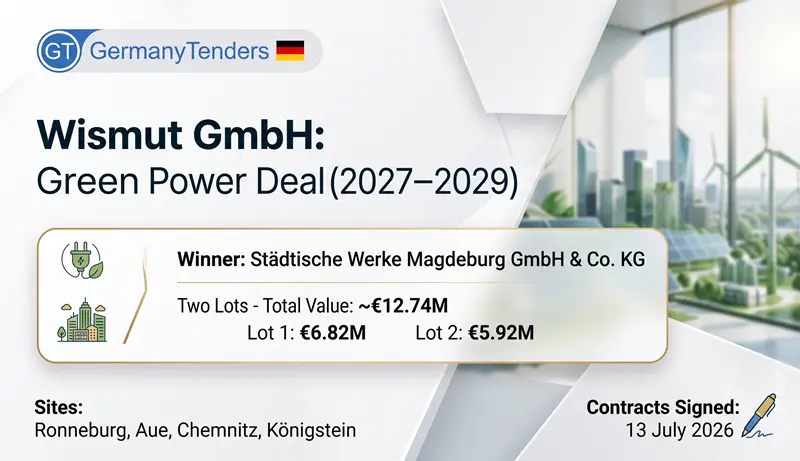
Wismut GmbH Secures €12.7 Million Framework for Green Electricity Supply Across Saxony Sites
17 Jul 2026
A framework agreement for the supply of renewable electricity worth up to €12.7 million has been awarded by Wismut GmbH. The contract, won by Städtische Werke Magdeburg GmbH & Co. KG, demonstrates how German public-sector entities are transitioning to renewable energy sources for their operational needs. Introduction Every industrial facility, office building, and operational site depends on reliable electricity to function. For Wismut GmbH, the German company responsible for the remediation of former uranium mining sites, ensuring a sustainable and cost-effective electricity supply is essential. The company has taken a significant step to address this by awarding a new framework agreement for the supply of renewable electricity (green electricity) to its sites across Saxony. While not a headline-grabbing infrastructure deal, this contract is fundamental to ensuring that Wismut's remediation operations are powered by sustainable energy. It reveals a great deal about how German public-sector entities are aligning their procurement practices with environmental sustainability goals. Why This Contract Matters Wismut GmbH is a company owned by the Federal Republic of Germany, responsible for the decommissioning and remediation of former uranium mining sites in Saxony and Thuringia. The company operates numerous facilities across the region, with significant electricity consumption. By procuring electricity exclusively from renewable sources, Wismut is reducing its carbon footprint and supporting Germany's energy transition (Energiewende). This contract also demonstrates how public-sector entities can leverage framework agreements to secure long-term, cost-effective renewable energy supply, providing budget certainty through 2029. Contract Timeline Contract award notice published: 17 July 2026 (OJ S 136/2026) Contract concluded: 13 July 2026 Coverage start date: 1 January 2027 Coverage end date: 31 December 2029 Contract Overview Wismut GmbH conducted an open procedure for the supply of electrical energy from renewable sources (green electricity) to its sites for the years 2027, 2028, and 2029. The contract is structured as two lots, covering different geographic locations. Both lots were won by Städtische Werke Magdeburg GmbH & Co. KG. The total maximum value of the framework agreements is €12,739,817. The contract is a framework agreement without reopening of competition, meaning that call-offs will be made directly against the framework terms. Key Contract Details Detail Information Contracting Authority Wismut GmbH Winning Bidder Städtische Werke Magdeburg GmbH & Co. KG Contract Subject Supply of renewable electricity (green electricity) - CPV 09300000 Procedure Type Open procedure Legal Basis Directive 2014/24/EU, VgV Total Maximum Framework Value €12,739,817.00 Lot 1 Maximum Value €6,819,062.00 Lot 2 Maximum Value €5,920,755.00 Contract Duration 1 January 2027 – 31 December 2029 (3 years) Lots 2 (Lot 1: Ronneburg; Lot 2: Aue, Chemnitz, Königstein) Award Criteria Price (100%) Bids Received 1 per lot (total 1 bidder for both lots) EU Funding None disclosed Covered by GPA No Review Organisation Bundeskartellamt, Vergabekammer des Bundes Lots Overview Lot Location Annual Consumption Estimates Max Value (€) Winner LOT-0001 Ronneburg site 2027: up to 14,700 MWh2028: up to 14,485 MWh2029: up to 14,465 MWh 6,819,062 Städtische Werke Magdeburg LOT-0002 Aue, Chemnitz and Königstein sites 2027: up to 10,559 MWh2028: up to 10,549 MWh2029: up to 10,549 MWh 5,920,755 Städtische Werke Magdeburg About the Contracting Authority Wismut GmbH is a company owned by the Federal Republic of Germany, responsible for the decommissioning and remediation of former uranium mining sites in Saxony and Thuringia. The company manages one of the largest environmental remediation projects in Europe, addressing the legacy of uranium mining that took place in the region during the Soviet and East German eras. Wismut operates numerous facilities across the region, with significant electricity consumption. The company is based in Chemnitz, Saxony. About the Winning Company Städtische Werke Magdeburg GmbH & Co. KG is a large German municipal utility company based in Magdeburg, Saxony-Anhalt. The company provides electricity, natural gas, water, heating, and waste management services to the Magdeburg region. With its expertise in renewable energy supply and distribution, Städtische Werke Magdeburg is well-positioned to deliver green electricity to Wismut's sites across Saxony. Procurement Analysis Procedure: An open procedure was used, which is the most transparent and inclusive method under EU law, allowing any interested supplier to submit a bid. Competition: Only one bid was received for each lot (submitted by Städtische Werke Magdeburg), and this bidder won both lots. This limited competition reflects the specialized nature of supplying renewable electricity to industrial sites with specific requirements, as well as the geographic scope of the contract. Award Criteria: Price was the sole award criterion, with 100% weight given to the total bid price. This pure price-based approach reflects the commodity nature of electricity supply, where the primary differentiator between bidders is cost. Framework Structure: The agreement is structured as a framework agreement without reopening of competition, meaning that Wismut can directly call off electricity supply against the framework terms without running further tender processes. Exclusion Provisions: The tender includes specific exclusion provisions in accordance with EU Regulation 2022/576, prohibiting the award of contracts to entities with Russian involvement exceeding 10% of the contract value. This reflects the EU sanctions regime following Russia's actions in Ukraine. GPA Status: The procurement is not covered by the Government Procurement Agreement (GPA), which explains why no international bidders participated in the tender. Additional Procurement Facts The contract covers medium and low-voltage electricity supply. No EU funding was used for this procurement. No dynamic purchasing system was used. No subcontracting was used by the winning bidder. The contract is a framework agreement without reopening of competition. Disputes or review requests fall to the Bundeskartellamt, Vergabekammer des Bundes (Federal Cartel Office, Federal Procurement Chamber) in Bonn. The tender included explicit references to compliance with German procurement regulations (GWB, VgV). Market & Industry Perspective The renewable electricity supply market in Germany is mature and competitive, with numerous municipal utilities and independent suppliers offering green electricity products. This contract demonstrates how public-sector entities can secure long-term renewable energy supply through framework agreements, providing price certainty and supporting sustainability goals. The pure price-based award criteria (100% price) reflects the reality of electricity procurement, where supply reliability and quality standards are generally well-established and regulated, making price the primary differentiator. The limited competition (only one bidder) may reflect the specific requirements of Wismut's sites, including the need for reliable supply to industrial remediation facilities, or it may indicate that other potential suppliers chose not to bid due to capacity constraints or pricing considerations. Economic Significance At up to €12.7 million over three years, this contract represents a substantial commitment to renewable energy procurement. It provides price certainty for Wismut through 2029, insulating the company from short-term electricity price volatility. The contract also supports Germany's Energiewende (energy transition) by ensuring that a significant public-sector electricity consumer is using 100% renewable energy. This contributes to reducing the carbon footprint of the country's environmental remediation operations. Future Procurement Opportunities This framework agreement covers the 2027-2029 period, with future renewals likely as the contract approaches its end. Other public-sector entities in Germany, including federal and state agencies, may adopt similar approaches to green electricity procurement as they seek to meet sustainability targets. The exclusive use of renewable energy in this contract may serve as a benchmark for other organizations seeking to align their procurement practices with environmental sustainability goals. Opportunities for Suppliers Energy suppliers and municipal utilities active in the German market should note the growing demand for green electricity from public-sector entities. The framework agreement structure offers multi-year revenue certainty for successful bidders. Key success factors include competitive pricing, reliable supply capability, and compliance with EU sanctions regulations. Suppliers should also be aware of the importance of demonstrating their ability to supply renewable electricity with appropriate certification and guarantees of origin. What Businesses Should Watch Whether other public-sector entities in Germany adopt similar framework agreements for green electricity supply. The uptake and actual consumption under this framework, which will determine the final contract value. Future tenders for electricity supply from Wismut and other remediation/industrial entities. The evolution of renewable energy certification requirements and supply chain transparency demands. GermanyTender Procurement Intelligence This contract is a useful case study in how German public-sector entities are transitioning to renewable energy procurement. Wismut GmbH, a federal government-owned remediation company, has secured a three-year framework for green electricity supply across its Saxony sites, demonstrating its commitment to sustainability. The most interesting feature of this tender is the pure price-based award criteria (100% price). For electricity procurement, this is a common approach, as electricity is a regulated commodity where quality standards and supply reliability are well-established. The focus on price ensures cost efficiency while maintaining the requirement for renewable energy certification. The limited competition (only one bidder) is notable. While this may reflect the specific requirements of Wismut's industrial sites, it also highlights the importance of building relationships with municipal utilities that can meet both price and sustainability requirements. Städtische Werke Magdeburg, with its established infrastructure and renewable energy portfolio, was clearly well-positioned to meet Wismut's needs. The inclusion of EU Regulation 2022/576 compliance provisions (relating to Russian involvement) is a reminder that public procurement in Germany must now navigate complex international sanctions regimes. This adds an additional compliance layer for bidders, particularly those with international supply chains. For suppliers, the lesson is that price competitiveness is essential in electricity procurement, but compliance with regulatory and sustainability requirements is equally important. Suppliers who can demonstrate both competitive pricing and robust renewable energy credentials are best positioned for these tenders. Supplier Takeaways Price is the dominant factor in green electricity tenders; suppliers must be highly cost-competitive. Framework agreements offer multi-year revenue certainty; securing a place is valuable. Compliance with EU sanctions regulations (Regulation 2022/576) is mandatory and must be demonstrated. Renewable energy certification and guarantees of origin are essential for green electricity supply. Strong relationships with municipal utilities and energy suppliers are valuable for long-term contracts. The market for green electricity in the public sector is growing, driven by sustainability commitments. Key Takeaways Wismut GmbH awarded a framework agreement for green electricity supply worth up to €12.7 million to Städtische Werke Magdeburg GmbH & Co. KG. The contract covers two lots: Ronneburg (€6.8 million) and Aue/Chemnitz/Königstein (€5.9 million). Only one bid was received for each lot, with the same bidder winning both. Award criteria: Price (100%). Contract duration: 1 January 2027 to 31 December 2029 (3 years). The contract supports Germany's energy transition by securing renewable electricity for Wismut's remediation operations. Conclusion This is not a contract that will make national headlines, but it reflects something structurally important about how German public-sector entities are transitioning to renewable energy. By awarding a €12.7 million framework for green electricity supply to Städtische Werke Magdeburg, Wismut GmbH ensures that its remediation operations across Saxony are powered by sustainable energy through 2029. The contract demonstrates the commitment of public-sector entities to sustainability while ensuring cost efficiency through competitive procurement. Frequently Asked Questions Q: What is Wismut GmbH? Wismut GmbH is a company owned by the Federal Republic of Germany, responsible for the decommissioning and remediation of former uranium mining sites in Saxony and Thuringia. Q: What does this contract cover? It covers the supply of renewable electricity (green electricity) to Wismut's sites at Ronneburg, Aue, Chemnitz, and Königstein for the years 2027-2029. Q: Why was only one bid received? The limited competition may reflect the specific requirements of Wismut's industrial sites, the geographic scope of the contract, or the availability of capacity among renewable electricity suppliers. Q: What is a framework agreement without reopening of competition? It is a contract structure where Wismut can directly call off electricity supply against the framework terms without running further tender processes for each call-off. Q: Is this contract funded by the EU? No. The notice confirms the project is not financed with EU funds, though it is governed by EU Directive 2014/24/EU.Source: EU Official Journal, Contract Award Notice 495562-2026, OJ S 136/2026, published 17 July 2026.
View Details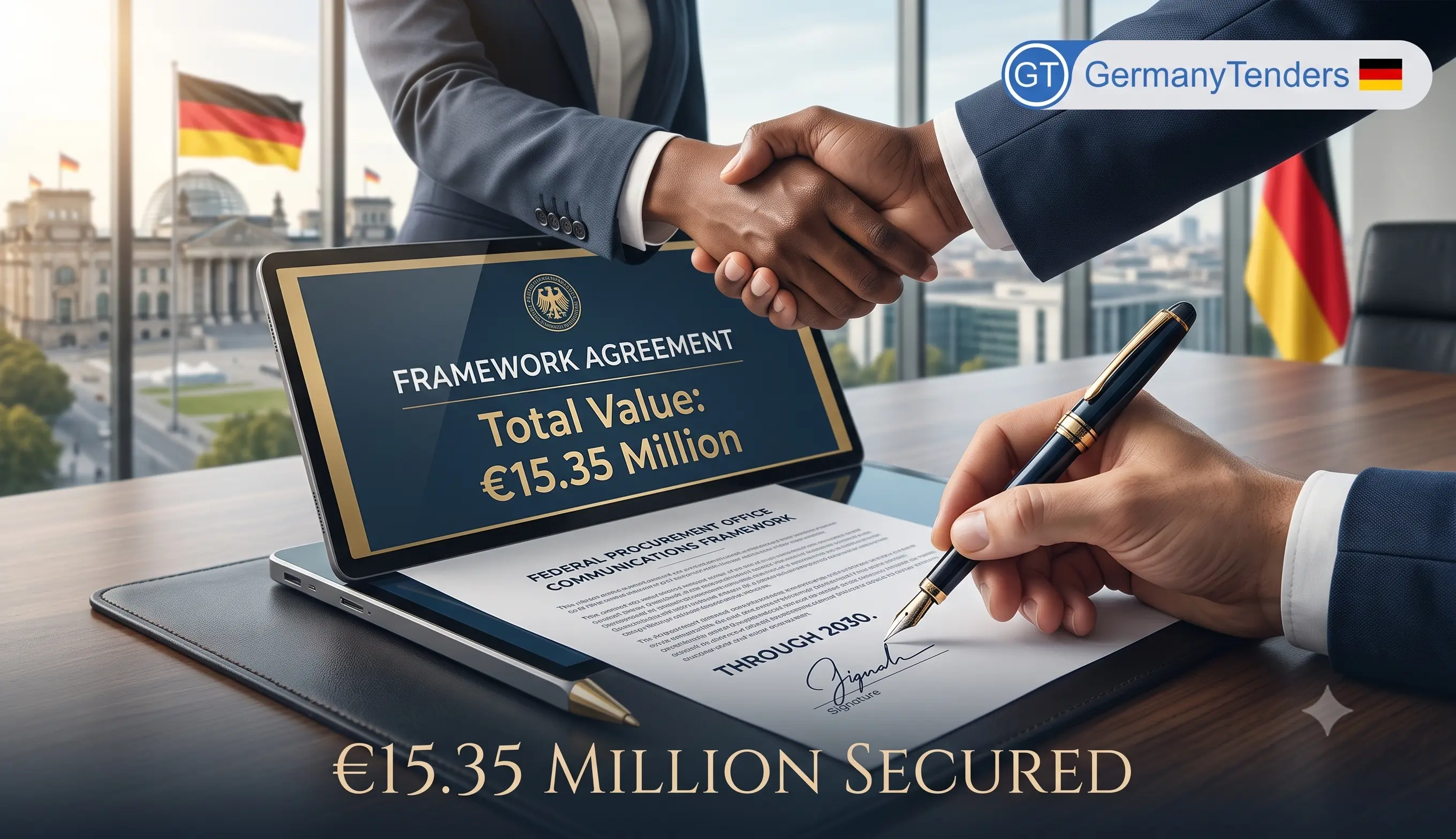
Germany's Federal Procurement Office Locks in €15.35 Million Communications Framework Through 2030
16 Jul 2026
A framework agreement for classic and digital communication services worth up to €15.35 million has been awarded by Germany's Federal Procurement Office (Beschaffungsamt des BMI). The contract, won by Serviceplan Berlin GmbH & Co. KG in an open procedure, demonstrates the federal government's structured approach to consolidating its public relations and digital outreach services. Introduction Every federal ministry, agency, and public institution in Germany relies on effective communication to engage with citizens, stakeholders, and the media. Managing a cohesive and professional communication strategy across such a vast landscape is a complex challenge. The Beschaffungsamt des BMI, the central procurement body for the Federal Ministry of the Interior, has taken a significant step to address this by awarding a new framework agreement for classic and digital communication services. While not a headline-grabbing infrastructure project, this contract is fundamental to ensuring consistent and high-quality public relations across the federal administration. It reflects a strategic move to streamline procurement, leverage economies of scale, and secure top-tier communication expertise. Why This Contract Matters Germany's federal structure means that individual ministries and agencies often procure communication services independently. This can lead to inefficiencies, varying quality standards, and higher costs. By centralizing this procurement through a framework agreement, the Beschaffungsamt des BMI aims to standardize services, reduce administrative overhead, and ensure that all federal entities have access to a reliable, pre-vetted pool of communication experts. For agencies and ministries, this framework provides a streamlined procurement channel, eliminating the need for lengthy individual tender processes for standard communication tasks. For the winning bidder, it offers a stable, multi-year revenue stream and a prestigious client base. Contract Timeline Contract Award Notice Published: 16 July 2026 (OJ S 135/2026) Date Winner Chosen: 09 June 2026 Contract Signed: 09 June 2026 Contract Overview The Beschaffungsamt des BMI conducted an open procedure, inviting any interested party to submit a tender. This transparent and competitive process ensures broad market participation. The contract is structured as a framework agreement without reopening competition for individual call-offs, meaning that once the contract is signed, the awarded bidder will fulfill all requests directly, without further tendering rounds. Key Contract Details Detail Information Contracting Authority Beschaffungsamt des BMI (Federal Procurement Office) Winning Bidder Serviceplan Berlin GmbH & Co. KG Contract Title (Lot) Los 1b: Framework Agreement for Classic and Digital Communication Contract Subject Public Relations Services (CPV 79416000) Procedure Type Open Procedure Legal Basis Directive 2014/24/EU, VgV (German Procurement Regulation) Estimated Value (ex-VAT) €15,350,000.00 Framework Agreement Ceiling €15,350,000.00 (maximum value of all call-offs) Tender Value (Bid Price) €156,059.00 (indicative price for the base scope) Bids Received 11 EU Funding None disclosed Covered by GPA No Contract Signed 09 June 2026 Project Scope The framework agreement covers a wide range of public relations services, divided into classic and digital communication. This includes, but is not limited to, strategic communication consulting, media relations, content creation, social media management, and digital outreach campaigns. The contract is designed to support the federal government's communication goals, ensuring that messages are effectively and professionally delivered across all channels. The service is not limited to a single ministry but is available to all federal entities under the auspices of the Beschaffungsamt des BMI. The specific tasks are detailed in individual call-offs ("Einzelabruf") based on the framework conditions. About the Contracting Authority The Beschaffungsamt des BMI (Procurement Office of the Federal Ministry of the Interior) is a central federal authority responsible for conducting public procurement on behalf of various federal entities. Its mission is to ensure efficient, transparent, and legally compliant procurement processes. This communications framework is a key part of its strategic procurement function, consolidating demand and achieving better value for the federal administration. About the Winning Company Serviceplan Berlin GmbH & Co. KG is a well-established communications agency and a part of the Serviceplan Group, one of Europe's largest and most successful agency networks. With a strong presence in Berlin, the heart of German politics, Serviceplan brings extensive experience in public sector communication, brand strategy, and digital innovation. Their expertise in "Digitale Maßnahmen" (digital measures) and "Social Media Leistungen" (social media services) aligns directly with the contract's focus on modern communication. The company is classified as a medium-sized economic operator. Procurement Analysis Procedure: An open procedure was used, which is the most standard and inclusive method under EU law. It allowed any interested company to submit a bid, fostering competition and maximizing the potential for the best quality-price ratio. A total of 11 tenders were received, indicating a healthy level of interest in the public sector communication market. Award Criteria: The evaluation criteria were heavily weighted towards quality. Quality was assigned a 70% weighting, while price accounted for 30%. This decision underscores the authority's focus on the "voraussichtliche Qualität der Leistung" (anticipated quality of service). This strategic choice emphasizes service delivery, creative excellence, and strategic value over the lowest bid. Framework Structure: The agreement is a "framework agreement without reopening of competition." This means that during the contract period, the contracting authority can directly award call-off contracts to Serviceplan Berlin within the agreed terms, without launching a new tender for each individual project. This structure provides significant efficiency and stability for both parties. GPA Status: The procurement is not covered by the Government Procurement Agreement (GPA). This may have influenced the nature of the competition, which was exclusively from German-based or European Economic Area (EEA) bidders, as no tenders were received from companies outside the EEA. Additional Procurement Facts The contract is part of a larger framework structure (KdB- Rahmenvereinbarung) for communication services. No dynamic purchasing system was used. Subcontracting is permitted, as indicated by the winner, but the value or percentage was not disclosed. Disputes or review requests fall to the Vergabekammer des Bundes (Federal Procurement Chamber) in Bonn. A total of 11 bids were received, with 6 of those coming from small or medium-sized enterprises (SMEs). Market & Industry Perspective The public sector communication market in Germany is significant and highly competitive. This contract is a prime example of how the federal government is strategically consolidating its procurement to gain influence and efficiency. By bundling its communication needs into a single, large framework, the government signals its intent to partner with top-tier agencies that can deliver across a broad spectrum of services. The weighting of the award criteria (70% quality, 30% price) is a notable trend. It suggests that public buyers are prioritizing strategic insight, creative quality, and reliable service over the lowest cost. This benefits established agencies with proven track records and strong infrastructure. Economic Significance With a maximum volume of over €15 million, this contract represents a substantial financial commitment and provides significant economic security for the winning agency. It ensures a predictable revenue stream and the stability to plan resources, invest in talent, and develop innovative services for the public sector. For the public sector, the framework agreement is expected to generate cost savings through volume pricing and reduced procurement costs. It also standardizes the quality of communication services across the federal administration, ensuring a professional and consistent public image. Future Procurement Opportunities This specific framework agreement is a part of a broader procurement strategy. The "KdB- Rahmenvereinbarung" likely encompasses multiple lots, with this being a specific part (Lot 1b). Future opportunities may arise for other service areas or as this framework is renewed. This contract serves as a benchmark for other federal, state, and even municipal-level procurement processes for communication services. Opportunities for Suppliers Agencies and communication consultancies looking to enter or expand in the public sector should note this contract's structure. The emphasis on quality, the need for a broad service portfolio (classic and digital), and the multi-year stability of the framework are key insights. To be competitive, agencies should demonstrate not only competitive pricing but also strong strategic capabilities, creative excellence, and a proven ability to manage the unique needs of government clients. What Businesses Should Watch The uptake and usage of the framework across different federal entities, which will indicate the demand for such services. Whether other federal and state bodies adopt similar consolidated framework structures for their communication needs. The re-tendering of this framework when it expires (likely in 4 years), providing a future opportunity to compete. GermanyTenders Procurement Intelligence This contract is a clear case study in how Germany is modernizing its public procurement. It tackles a structural problem—fragmented communication buying across ministries—by centralizing demand through a framework agreement. This approach not only achieves better value for money but also allows the government to build a strategic, long-term partnership with a single, high-quality provider. The most significant takeaway is the 70% weighting for quality. This confirms that for complex service contracts, price is becoming a secondary consideration. The focus is on the ability to deliver a high-quality, strategic service that can enhance the government's communication effectiveness. This shift rewards agencies that invest in their people, processes, and creative output. For suppliers, the lesson is clear: competing on strategic thinking, digital innovation, and service reliability—not just price—is what wins these tenders. Agencies that can demonstrate strong creative and strategic capabilities, rather than simply undercutting rivals, are best placed as more federal and state bodies adopt similar framework structures over the coming years. Supplier Takeaways Investing in strategic communication consultancy and digital expertise is crucial for public sector tenders. Demonstrate the quality of your service through detailed methodologies, case studies, and proof of performance. Be prepared to compete in open procedures, as transparency is a core principle. Understand the importance of framework agreements; winning them provides long-term stability. Subcontracting is a viable option, but the prime bidder must be prepared to manage the entire service delivery. Key Takeaways Beschaffungsamt des BMI awarded a 4-year framework for PR services to Serviceplan Berlin GmbH & Co. KG, worth up to €15.35 million. An open procedure was used, receiving 11 tenders. The award was based on a 70% quality / 30% price weighting. The contract bundles communication services for multiple federal entities, promoting efficiency and standardization. The framework agreement allows for direct call-offs without re-tendering individual projects. Conclusion This contract may not be a headline-grabbing infrastructure project, but it is a strategically vital piece of the federal administration's machinery. By awarding a €15.35 million framework agreement to Serviceplan Berlin, the Beschaffungsamt des BMI has secured high-quality, efficient, and standardized communication services for the German government. The weighting of quality over price signals a maturing procurement approach that values strategic partnership and service excellence. This model of centralizing procurement for professional services is a growing trend in the public sector, setting a benchmark for future tenders. Frequently Asked Questions Q: What is the Beschaffungsamt des BMI? It is the central procurement office for the German Federal Ministry of the Interior, responsible for conducting tenders for various federal authorities. Q: What does this framework cover? It covers "classic and digital communication" services (CPV 79416000), including public relations, media relations, social media, and digital strategy. Q: How long is the contract for? The specific duration is not listed, but framework agreements of this type are typically for 4 years, as is the case in the French example. The text states it covers the "KdB- Rahmenvereinbarung für klassische und digitale Kommunikation" with the start date being the date of the contract (June 9, 2026). Q: Why was price not the main criterion? The authority prioritized quality (70%) to ensure high professional standards and strategic value for its communication efforts, rather than just choosing the lowest cost provider. Q: Is the contract open to international bidders? It is not covered by the GPA, and all 11 tenders received were from Germany or the EEA, suggesting the market is effectively domestic or European. Source: EU Official Journal, Contract Award Notice 493115-2026, OJ S 135/2026, published 16 July 2026. body { font-family: Arial, sans-serif; line-height: 1.6; margin: 30px; max-width: 1000px; margin-left: auto; margin-right: auto; } h2 { border-bottom: 1px solid #ccc; padding-bottom: 5px; color: #1a3b5c; } table { width: 100%; border-collapse: collapse; margin: 20px 0; } th, td { border: 1px solid #ddd; padding: 10px; vertical-align: top; } th { background-color: #f2f2f2; font-weight: bold; } ul { margin-bottom: 15px; } .highlight { background-color: #f9f9f9; padding: 10px; border-left: 4px solid #1a3b5c; } .section { margin-bottom: 25px; }
View Details