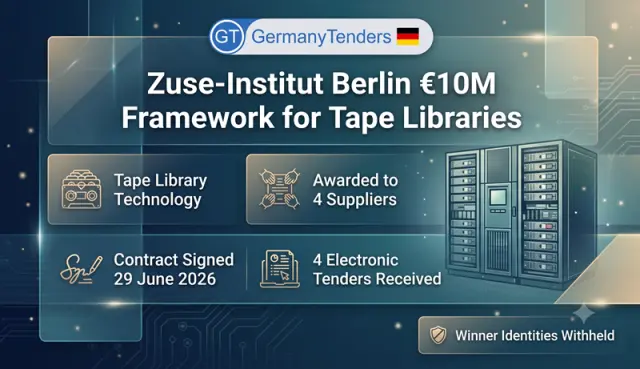
Berlin's Zuse Institute Locks In €10M Data Storage Framework with Four Suppliers Through 2032
15 Jul 2026
Zuse-Institut Berlin - €10M Tape Library Framework Berlin's Zuse-Institut Berlin has awarded a framework agreement worth up to €10 million for tape library storage technology to four suppliers, with identities withheld under German procurement law. The 72-month contract, signed on 29 June 2026, covers hardware, software, implementation and services for large-scale data storage, reflecting the institute's long-term commitment to tape and archive technologies. Introduction Every research institute depends on reliable data storage. When that data grows into petabytes, the infrastructure choices become strategic. At the Zuse-Institut Berlin (ZIB), a public research institute focused on mathematics and high-performance computing, that strategic decision now rests on a framework agreement with four unnamed suppliers for tape library technology. It is not a flashy IT services deal. But it is the kind of contract that keeps scientific computing running, and it reveals how German public research bodies are approaching long-term data storage procurement. Why This Contract Matters Germany's research institutes face a fundamental challenge: data volumes grow continuously, but storage hardware must be replaced on cycles that often outlast typical procurement frameworks. Tape technology, known for its longevity and cost efficiency, offers a solution. But buying it through standard tenders, with rigid volumes and short terms, creates administrative friction. This framework agreement solves that by establishing a flexible, multi-supplier vehicle that the institute can draw on for both upgrades to existing systems and entirely new deployments from diverse manufacturers. The absence of a purchase commitment ("keine Abnahmeverpflichtung") gives ZIB procurement flexibility, while the long term gives suppliers predictable access to a demanding public-sector client. Contract Timeline Contract award notice published: 15 July 2026 (OJ S 134/2026) Contract concluded: 29 June 2026 Initial term: 48 months (4 years) Automatic renewals: 2 x 12 months Maximum total term: 72 months (6 years) Contract Overview The Zuse-Institut Berlin ran an open procedure under EU Directive 2014/24/EU, receiving four tenders, all submitted electronically. Three of those came from micro, small or medium-sized enterprises. The result is a framework agreement with four suppliers, structured partly without reopening and partly with reopening of competition, meaning some call-offs will be placed directly while others will be re-competed among the four. The identities of the winning suppliers have been withheld. The contracting authority invoked §39 Satz 6, Ziff. 3 & 4 of the German procurement regulations, which allows the buyer to withhold supplier names where disclosure would harm commercial interests or where there are multiple winners and individual details are not material. Key Contract Details Detail Information Contracting authority Zuse-Institut Berlin Winning bidders 4 suppliers (identities withheld) Contract subject Tape library storage technology (hardware, software, implementation, services), CPV 30200000 Procedure type Open procedure Legal basis EU Directive 2014/24/EU, VgV Approximate framework value €10,000,000 Initial term 48 months (4 years) Maximum term 72 months (6 years, incl. 2 renewals of 12 months) Bids received 4 SME bids 3 EU funding None disclosed Covered by GPA No Contract signed 29 June 2026 Project Scope The framework covers the procurement of tape-library-technology-based solutions, including hardware and software, plus associated implementation and service deliveries. The scope explicitly includes both continuous expansion and modernisation of existing data storage technology and the procurement of entirely new storage technology from various manufacturers. The institute has no obligation to make purchases ("Abnahmeverpflichtung besteht nicht"). This is a purely discretionary framework, meaning ZIB can issue call-offs as and when requirements arise, without committing to minimum volumes. About the Contracting Authority Zuse-Institut Berlin (ZIB) is a public research institute and a member of the Leibniz Association. It conducts research in mathematics and high-performance computing, and operates one of Germany's leading supercomputing centres. Its data storage needs are correspondingly large and long-term, making tape and archive technologies a natural fit. About the Winning Companies The four winners are not named publicly. The contracting authority has confirmed that they are suppliers or manufacturers of tape library technology, and that subcontracting is involved: awards under the framework will be placed with a subcontractor. The winners are categorised as medium-sized economic operators. Procurement Analysis Procedure: An open procedure was used, meaning any interested supplier could submit a tender. This is the standard route for supplies contracts where the requirements are well-defined and the buyer does not need extensive negotiation. Competition: Four tenders were received. For a specialist storage technology market, this is a healthy level of competition. Notably, three of the four bidders were SMEs, indicating that the procurement was accessible to smaller players in what is often a niche market. Evaluation criteria: Price was the sole award criterion ("Preis"). The contracting authority has not published further detail on how price was evaluated, but with a single criterion, the award would have gone to the most economically advantageous tender based solely on cost. Framework structure: The agreement is partly without reopening and partly with reopening of competition. This hybrid structure allows ZIB to place smaller or urgent orders directly with one of the four suppliers, while larger or more complex projects can be re-competed among the panel. GPA status: The procurement is not covered by the Government Procurement Agreement (GPA). This means international suppliers from non-EU GPA signatories could not claim access rights under the GPA, though the open procedure was still open to all bidders. Additional Procurement Facts The framework runs for an initial 48 months, with two automatic 12-month renewals unless the buyer cancels with 3 months' notice. The maximum term of 72 months reflects the long lifecycle and durability of tape and archive technologies. No dynamic purchasing system was used. The review body is the Vergabekammer des Landes Berlin. Market & Industry Perspective Tape storage is a niche but persistent segment of the data storage market. While flash and disk dominate primary storage, tape remains the medium of choice for long-term archival, cold storage and backup, due to its low cost per terabyte, energy efficiency and durability. For research institutions with multi-petabyte archives, tape is often the only economically viable option. This contract reflects a broader trend: public research bodies are moving away from single-supplier, short-term procurements for storage and towards multi-supplier, long-term frameworks. The six-year maximum term here is unusually long for IT hardware and signals ZIB's confidence in the longevity of tape technology. Economic Significance At €10 million over up to six years, this is not a huge contract by public procurement standards. But it represents the entire storage procurement budget for a major research institute for the medium term. For the four winning suppliers, the framework offers guaranteed access to a demanding, technically sophisticated client, without the need to re-bid every individual purchase. The lack of purchase commitment means the real value will depend on ZIB's actual call-offs. But the framework's existence gives both the institute and the suppliers planning security through to 2032. Future Procurement Opportunities The open nature of the framework, with its hybrid call-off structure, means that individual opportunities will arise throughout the contract term. Suppliers not on the panel are effectively excluded, but the four winners will have ongoing chances to win call-offs, particularly for larger projects where competition is reopened. Beyond this specific contract, similar frameworks at other German research institutes and universities are likely to follow. The ZIB model, with its long term, multi-supplier structure and flexible scope, could become a reference for other public buyers of tape and archive storage. Opportunities for Suppliers For manufacturers and distributors of tape library technology, the key takeaway is that German research institutions are consolidating their storage procurement into long-term, multi-supplier frameworks. Winning a place on such a panel requires competitive pricing, given the sole price criterion here, and the ability to deliver a broad range of hardware, software and services. Subcontracting is explicitly contemplated, meaning specialist service providers may find opportunities through the four panel suppliers, even if they are not direct winners. What Businesses Should Watch Whether other Leibniz Association institutes and German research centres adopt similar long-term, multi-supplier frameworks for storage. The actual call-off patterns under this framework, which will signal whether ZIB's procurement volume matches the €10 million estimate. Any challenge to the non-disclosure of supplier identities, which could set a precedent for future German procurement notices. GermanyTenders Procurement Intelligence This contract is a case study in how German public research bodies are adapting procurement to match technology lifecycles. Tape storage is not replaced every two or three years; it is a long-term infrastructure investment. A six-year framework, with no minimum purchase commitment, reflects that reality far better than a standard two-year IT supplies contract. The sole price criterion is notable. In a market dominated by a small number of specialist suppliers, and where the buyer is technically sophisticated, price may be the only meaningful differentiator. ZIB likely has very clear technical requirements, leaving little room for quality scoring beyond price competition. The withholding of supplier identities is legally permissible but unusual. It will be interesting to see whether this becomes a more common practice in German procurement, particularly in specialist technology markets where disclosing winners could reveal commercial strategy to competitors. Supplier Takeaways Price is the decisive factor; bidders must submit their most competitive pricing to win a place on the panel. The framework is long-term, offering revenue predictability for winners through to 2032. Subcontracting is allowed, creating opportunities for specialist service providers to work with panel suppliers. Three of the four winners are SMEs, demonstrating that the German procurement system is accessible to smaller firms in this sector. The hybrid call-off structure means both direct awards and re-competed opportunities will arise; winners should stay engaged throughout the term. Key Takeaways Zuse-Institut Berlin awarded a €10 million framework for tape library storage technology to four unnamed suppliers. The contract runs for an initial 48 months, with two automatic 12-month renewals, taking it to 72 months maximum. Four tenders were received; three were from SMEs. Price was the sole award criterion. The identities of the four winners are withheld under §39 Satz 6, Ziff. 3 & 4. Conclusion This is not a high-profile contract, but it reflects a thoughtful approach to public procurement in a specialist technology field. By establishing a long-term, multi-supplier framework with no purchase commitment, Zuse-Institut Berlin has given itself the flexibility to manage evolving storage needs, while giving suppliers a stable route to a demanding public-sector client. The contract runs through to 2032, by which time the institute's data storage landscape will likely have transformed again. Frequently Asked Questions Q: What is a framework agreement? It is a master contract that sets terms for future purchases. The buyer is not obliged to buy, but when it does, it can do so under agreed conditions without running a new full tender. Q: Why are the suppliers not named? The contracting authority invoked §39 Satz 6, Ziff. 3 & 4 of the German procurement regulations, which permits the withholding of winner names in certain circumstances, including to protect commercial interests. Q: What is tape library technology? It is a storage system using magnetic tape cartridges, typically for long-term archival, backup and cold storage. It is known for low cost per terabyte, high durability and low energy consumption compared to disk or flash storage. Q: Why does the contract run for up to 72 months? Tape and archive technologies have a long lifecycle and are durable over many years. A long contract term is considered appropriate and economically sensible for this type of product. Q: Is this contract covered by the GPA? No. The notice explicitly states the procurement is not covered by the Government Procurement Agreement.Source: EU Official Journal, Notice publication number: 490485-2026, OJ S 134/2026, published 15 July 2026.
View Details
Berlin's IT Backbone Locks In a €50 Million Data Center Network Upgrade Through Controlware
14 Jul 2026
Berlin's public IT services provider has awarded a four-year framework agreement worth up to €50.36 million for data center network equipment from Arista Networks, covering expansions, upgrades, replacements, and ongoing maintenance. The deal, won by Controlware GmbH, keeps the digital infrastructure behind the German capital's public administration running for the next four years.IntroductionEvery public service in Berlin, from citizen registration systems to internal government networks, depends on data centers that never go down. IT-Dienstleistungszentrum Berlin (ITDZ Berlin), the city's central IT service body, has awarded a new framework agreement to secure the network hardware and services that keep those data centers connected. The contract, capped at €50,360,000 over 48 months, covers Arista Networks-branded data center LAN components, along with system maintenance and support for both new and existing equipment.It is not a consumer-facing announcement, but it is the kind of contract that determines how reliably Berlin's government IT systems function behind the scenes.Why This Contract MattersPublic administrations increasingly run their own data centers to host citizen services, internal applications, and shared infrastructure for multiple government agencies. As demand grows, that infrastructure needs to expand, be replaced, and be maintained continuously, without interruption to public services.This contract gives ITDZ Berlin a single, pre-negotiated route to acquire data center LAN network components as needed, rather than running a new tender every time equipment needs to be added or replaced. For Controlware, it secures a large, multi-year revenue stream supplying and supporting networking hardware for one of Germany's largest public sector IT operators.Contract TimelinePrevious framework notice referenced: 135740-2026Winner selected: 30 June 2026Contract concluded: 13 July 2026Contract award notice published: 14 July 2026 (OJ S 133/2026)Framework duration: 48 months from conclusionContract OverviewITDZ Berlin ran an open procedure, meaning any qualified supplier could submit a tender without a pre-qualification stage. The contract is structured as a single lot covering the supply of Arista Networks data center LAN components, including hardware for expansions, technical adjustments, and replacement of existing equipment, as well as ongoing maintenance and system service for both new and previously installed components.Only two tenders were submitted electronically, a relatively narrow field reflecting the specialised nature of single-vendor networking hardware procurement, where suppliers typically need established distribution or reseller relationships with the named manufacturer.Key Contract DetailsProject ScopeThe framework agreement covers data center LAN network components manufactured by Arista Networks, a US-based provider of high-performance networking equipment widely used in large-scale data center environments. The scope spans new procurement for capacity expansions and technical changes, replacement of aging or faulty components, and ongoing maintenance and care, described in the notice as "Systemservice", for both newly supplied and existing stock equipment.The agreement is a framework agreement without reopening of competition, meaning Controlware will deliver call-off orders directly for the duration of the contract, rather than ITDZ Berlin re-tendering individual purchases as needs arise.About the Contracting AuthorityITDZ Berlin is a body governed by public law, controlled by a regional authority, and serves as the central purchasing body for IT supplies and services used by public administration in Berlin. Its role includes acquiring and maintaining shared technical infrastructure, such as data center networking, that individual Berlin government agencies would otherwise need to procure separately.About the Winning CompanyControlware GmbH is a large German IT systems integrator headquartered in Dietzenbach, near Frankfurt. The company specialises in networking, data center, security, and communications infrastructure, and works extensively with public sector clients across Germany. For this contract, Controlware operates as sole tenderer with no subcontracting declared.Procurement AnalysisProcedure: An open procedure was used, standard for large-scale, clearly specified equipment framework agreements where technical requirements are already well defined around a named manufacturer's product line.Competition: Two tenders were received electronically. That is a narrow but plausible level of competition for single-manufacturer networking hardware, where few resellers or integrators hold the necessary distribution agreements and technical certifications for Arista Networks equipment at this scale.Evaluation criteria: The contract was awarded on 100% price, meaning technical specifications were treated as fixed requirements rather than differentiators, and the tender with the lowest compliant price won.Framework structure: The agreement was awarded without reopening competition, so Controlware will fulfil orders directly as ITDZ Berlin's needs arise over the four-year term.GPA status: The contract falls under the World Trade Organization's Government Procurement Agreement, meaning it was, in principle, open to qualifying international bidders.Additional Procurement FactsThe contract references a prior notice (135740-2026), which established the earlier stage of this procurement.No dynamic purchasing system was used.The procurement was not financed with EU funds.Disputes or review requests fall to the Vergabekammer des Landes Berlin (Berlin State Public Procurement Tribunal).The tender value recorded for Controlware in the notice (€45,781,000) matches the contract's estimated value, with the framework ceiling set higher at €50,360,000 to allow for demand growth over the four-year term.Market and Industry PerspectivePublic sector data center networking contracts of this size are relatively rare outside the largest cities and federal agencies, since few municipal or regional bodies operate infrastructure at a scale requiring dedicated, branded framework agreements. Berlin's decision to standardise on Arista Networks components reflects a broader trend among large public IT operators toward consolidating around a single vendor's ecosystem to simplify maintenance, staff training, and interoperability across a growing data center footprint.For systems integrators like Controlware, contracts structured this way reward established manufacturer partnerships and the logistical capacity to deliver both new hardware and long-term maintenance under one agreement.Economic SignificanceAt up to €50.36 million over four years, this is a substantial technology contract by German municipal standards, reflecting the scale of the data center infrastructure required to support Berlin's public administration. The framework structure gives both ITDZ Berlin and Controlware budget predictability, letting equipment purchases and maintenance be planned incrementally rather than through repeated, separate tenders.Future Procurement OpportunitiesBecause the framework was awarded without reopening competition, Controlware is positioned to receive further call-off orders throughout the 48-month term as ITDZ Berlin's data center capacity needs evolve. Other German public IT bodies expanding similarly large data center operations may look to this contract's single-vendor, price-based structure as a reference model.Opportunities for SuppliersNetworking equipment resellers and integrators with strong manufacturer partnerships, particularly around leading data center networking brands, should note that large public IT operators increasingly favour consolidated, price-driven framework agreements over piecemeal purchasing. Building certified reseller status with major networking vendors appears to be a prerequisite for competing in this segment.What Businesses Should WatchWhether ITDZ Berlin issues further framework agreements as its data center capacity expands beyond this contract's scope.How heavily other large German public IT bodies weight price versus technical criteria in similar networking hardware tenders.Whether single-vendor consolidation around specific networking brands becomes more common across German public sector data centers.Procurement Intelligence CommentaryThis contract is a useful illustration of how large public IT operators manage growing data center demand: rather than tendering every hardware purchase separately, ITDZ Berlin has locked in a single supplier relationship covering new equipment, replacements, and maintenance for four years. The 100% price-based award criteria signals that, for well-specified, single-vendor hardware procurement, cost efficiency, not technical differentiation, is the deciding factor once a manufacturer standard has already been set.For suppliers, the lesson is that competing for these contracts depends less on service innovation and more on securing the manufacturer partnerships and logistics scale needed to deliver consistently over a multi-year term.Supplier TakeawaysPublic sector data center networking framework agreements reward established manufacturer reseller relationships over general IT service breadth.Price was the sole award criterion here, suggesting technical specification was already fixed around a named manufacturer.Framework agreements without reopened competition offer suppliers multi-year revenue certainty once won.Narrow competition (two bidders) suggests significant barriers to entry in specialised networking hardware procurement.Key TakeawaysITDZ Berlin awarded a data center LAN networking framework agreement worth up to €50.36 million to Controlware GmbH.The contract covers Arista Networks equipment, including expansions, replacements, and maintenance services.The four-year framework runs through 48 months from the July 2026 contract signing.Two electronic tenders were received under an open procedure decided entirely on price.The agreement was awarded without reopening competition, giving Controlware direct fulfilment rights for the full term.ConclusionThis contract will not make national headlines, but it reflects the quiet, continuous investment required to keep large-scale public sector IT infrastructure running. By locking in a single supplier for data center networking hardware and maintenance, ITDZ Berlin secures predictable capacity growth for Berlin's public administration, while Controlware gains a substantial, multi-year public sector engagement.Frequently Asked QuestionsQ: What is ITDZ Berlin? It is the central IT service and purchasing body for Berlin's public administration, responsible for acquiring and maintaining shared technology infrastructure.Q: What does this contract cover? It covers data center LAN network components from Arista Networks, including new equipment, replacements, technical adjustments, and ongoing maintenance.Q: Why was price the only award criterion? Because the equipment and technical requirements were tied to a specific named manufacturer, leaving price as the primary differentiator between qualifying tenders.Q: Is this contract funded by the EU? No. The notice confirms the project is not financed with EU funds, though it is governed by EU Directive 2014/24/EU and covered by the WTO's Government Procurement Agreement.Contract DetailsDetailInformationContracting authorityIT-Dienstleistungszentrum Berlin (ITDZ Berlin)Winning bidderControlware GmbHContract subjectData center LAN network components (Arista Networks), CPV 32400000Procedure typeOpen procedureLegal basisEU Directive 2014/24/EUEstimated value (ex-VAT)€45,781,000Maximum framework value€50,360,000Contract duration48 monthsBids received2 (submitted electronically)EU fundingNone disclosedCovered by GPAYesAward criteria100% PriceWinner selected30 June 2026Contract signed13 July 2026Source: EU Official Journal, Notice publication number: 484335-2026, OJ S 133/2026, published 14 July 2026.
View Details
German Municipal IT Alliance Secures €14.2 Million Framework for Prowise Digital Displays Across North Rhine-Westphalia
13 Jul 2026
KDN Dachverband, a German municipal IT service provider alliance, has awarded a framework agreement worth up to €14.2 million for the supply of Prowise brand digital displays to eight municipal entities across North Rhine-Westphalia. The deal, won by Prowise GmbH, will equip schools and municipal facilities with interactive touchscreen displays over a maximum four-year term. The contract illustrates how German municipalities are centralizing procurement for education technology to achieve economies of scale.IntroductionEvery modern classroom depends on digital displays for interactive teaching. Someone has to ensure that schools have the right equipment, at the right price, and that it gets delivered when needed. In North Rhine-Westphalia, that responsibility now sits with Prowise GmbH, after KDN Dachverband, a municipal IT service provider alliance, signed off on a new framework agreement worth up to €14.2 million for the supply of digital displays.It is not a headline-grabbing infrastructure deal. But it is the kind of contract that keeps Germany's schools equipped for digital learning, and it says a great deal about how municipal entities are centralizing procurement to achieve better value for money.Why This Contract MattersGermany's municipalities are individually responsible for equipping their schools and administrative facilities. But individually, they lack the purchasing power to negotiate favorable terms with technology suppliers. This contract is a textbook example of how municipal alliances aggregate demand to achieve economies of scale.KDN Dachverband acts as a central purchasing body for its member municipalities. By bundling the display requirements of eight entities across North Rhine-Westphalia, KDN secures consistent pricing, streamlined procurement, and reduced administrative burden for its members.For suppliers, the contract provides a direct route to a large, fragmented client base that would otherwise be commercially unreachable. For municipalities, it means access to volume pricing and standardized equipment they could never secure alone.Contract TimelinePrevious notice referenced: None specified (this is the initial result notice)Winner chosen: 9 July 2026Contract concluded: 9 July 2026Contract start date: 9 July 2026Initial contract term: 12 months (1 year)Renewal options: Two additional one-year extensions (maximum 4 years total)Contract OverviewKDN Dachverband ran an open procedure for this framework agreement, inviting suppliers of digital displays to submit tenders. The evaluation criterion was 100% price, with the contract awarded to the lowest priced compliant bidder. Only one tender was received, from Prowise GmbH.The result is a framework agreement without reopening of competition, covering the supply of Prowise brand digital displays to eight eligible member entities:KDN DachverbandStadt EssenStadt Bochum SchulverwaltungStadt HagenStadt MünsterciteqStadt OberhausenStadt RemscheidThe estimated total value is €14,211,502 excluding VAT over the full potential term (including extensions). The contract is for an initial one-year period, with options for two additional one-year extensions, potentially extending through mid-2030.Key Contract Details Detail Information Contracting authority KDN Dachverband Kommunaler IT-Dienstleister Winning bidder Prowise GmbH Contract subject Supply of digital displays (CPV 30200000, 48000000) Brand specified Prowise Procedure type Open procedure Legal basis Directive 2014/24/EU, § 15 VgV Estimated value (ex-VAT) €14,211,502 Initial contract term 1 year (from 9 July 2026) Renewal options Two additional 1-year extensions (max 4 years total) Bids received 1 SME participation 1 (the winning bidder is medium-sized) EU funding No Covered by GPA Yes Contract concluded 9 July 2026 Award notice published 13 July 2026 (OJ S 132/2026) Project ScopeThe contract covers the supply of Prowise brand digital displays to the eight eligible member entities. The displays are intended for use in:Schools and educational facilitiesMunicipal administrative facilitiesOther public facilities operated by the member entitiesKey Features of the Framework:Product brand: Prowise (specific models detailed in the procurement documents)Delivery locations: Various locations across North Rhine-Westphalia, as specified in Annex 1 of the procurement documentsContract type: Framework agreement without reopening of competitionDuration: Initial 1-year term with automatic renewal optionsRenewal Mechanism:The contract automatically renews for one year at a time, unless either party gives written notice at least five months before the end of the current term. A second automatic renewal is possible, bringing the maximum total term to four years. Further renewals are excluded unless exceptionally permitted by law.About the Contracting AuthorityKDN Dachverband Kommunaler IT-Dienstleister is a public undertaking based in Siegburg, North Rhine-Westphalia. KDN acts as an umbrella organization and central purchasing body for municipal IT service providers across Germany. Its role is to aggregate demand for IT products and services, achieving economies of scale for its members.For this contract, KDN acted as:Central purchasing body acquiring supplies intended for other buyersCentral purchasing body awarding framework agreements intended for other buyersThe contracting authority managing the procurement procedureThe organization providing access to procurement documentsKDN's membership includes numerous municipal IT service providers across Germany, giving it significant purchasing power in the public sector IT market.About the Winning CompanyProwise GmbH is a medium-sized company based in Cologne, Germany (registration number HRB91595 Köln). Prowise is the German subsidiary of the Prowise Group, a global provider of interactive display solutions for education and corporate environments.Prowise is well-known in the education technology market for its interactive flat panels, touchscreen displays, and educational software solutions. This contract strengthens its position in the German municipal education technology market and provides a platform for expansion across the KDN member network.The company submitted the only tender for this contract and was ranked as the sole winner. No subcontracting is planned.Procurement AnalysisProcedure: An open procedure was used, the standard format for EU public procurement, ensuring full transparency and equal access for all qualified bidders in the single market. The procedure was not accelerated, indicating a standard timeline was followed.Competition: Only one tender was received. This raises questions about competitive intensity. Factors may include:The contract's specification of a specific brand (Prowise), which may have limited participation from suppliers offering alternative brandsThe specialized nature of interactive display procurement in the education technology marketPotential supplier awareness or bidding capacity issuesAdministrative barriers or cost of bidding relative to contract valueEvaluation criteria: The award criterion was 100% price, meaning the winning bid was the cheapest among those that met all technical specifications. The contract was awarded to the lowest priced compliant tenderer.Framework structure: The agreement is a framework without reopening of competition, meaning Prowise GmbH will deliver directly for the duration. This provides long-term revenue certainty for the supplier and procurement efficiency for the buyer.GPA status: The contract falls under the WTO's Government Procurement Agreement, meaning it was open to qualifying international bidders. No tenders were received from outside the European Economic Area.SME participation: The sole bidder and winner (Prowise GmbH) is classified as a medium-sized enterprise. No tenders were received from micro or small enterprises.Additional Procurement FactsThe contract references no previous notice, suggesting this is the initial framework rather than a renewal.No dynamic purchasing system was used.The procurement is not financed with EU funds.The contract includes a significant value of €14.2 million across the full potential term.Review of procurement decisions falls to the Vergabekammer Rheinland, with review deadlines under German procurement law.The contract is governed by German procurement law (VgV) implementing Directive 2014/24/EU.Review Deadlines under German Law:Alleged violations must be raised within 10 calendar days of recognitionViolations apparent from the contract notice must be raised by the deadline for applications or offersViolations apparent from procurement documents must be raised by the deadline for applications or offersMore than 15 calendar days after the contracting authority's notice of non-compliance with a complaintMarket & Industry PerspectiveThe education technology market in Germany is undergoing significant growth, driven by the federal government's DigitalPakt Schule initiative, which has provided billions of euros for digital equipment in schools. Municipalities are the primary buyers of this equipment, but they often lack the procurement scale to negotiate favorable terms.Centralized purchasing bodies like KDN Dachverband are addressing this challenge by aggregating demand across member municipalities. This contract is one example of how these structures are being used to achieve economies of scale in education technology procurement.The specification of a specific brand (Prowise) is notable. While brand-specific contracts are permitted under EU procurement rules where justified by technical requirements, they can limit competition. The fact that only one tender was received suggests that the brand-specific nature of the contract may have deterred other suppliers.For suppliers, the lesson is that municipal procurement alliances represent significant opportunities, but contracts may specify particular brands or technical standards that create barriers to entry.Economic SignificanceAt up to €14.2 million over four years, this contract represents a significant investment in digital infrastructure for schools and municipal facilities across North Rhine-Westphalia. The contract directly supports the digital transformation of German classrooms, providing interactive displays that enable modern teaching methods.The four-year potential term provides budget predictability for the participating municipalities and revenue certainty for Prowise GmbH. The centralized procurement structure also reduces administrative overhead for municipalities, who would otherwise need to run individual procurement processes.Future Procurement OpportunitiesThe two one-year extension options embedded in this contract mean additional orders may follow as member entities procure displays over the coming years. Beyond this specific contract, KDN Dachverband and other municipal alliances run comparable tenders on their own cycles.Specifically:Other German states: Similar municipal IT alliances in other German states may run comparable display tenders.Expanded product categories: The same framework might be extended to cover additional interactive display models or accessories.New member entities: Additional municipalities may join the KDN network and become eligible to purchase under this framework.Opportunities for SuppliersTechnology suppliers active in the German education sector should note that contracts of this kind recur through municipal alliances and central purchasing bodies. Firms with strong product offerings, competitive pricing, and the ability to supply across multiple municipalities are well-positioned.Key Success Factors:Competitive pricing (100% price criterion here)Brand recognition and technical acceptanceAbility to supply across multiple locationsCapacity to meet delivery and installation requirementsUnderstanding of municipal procurement processesThe contract's specification of a specific brand suggests that suppliers should consider establishing relationships with municipal alliances or, alternatively, competing on the basis of comparable technical specifications in future tenders.What Businesses Should WatchExtension decisions: Whether member entities exercise the extension options will indicate satisfaction with Prowise products and service.Other KDN tenders: KDN runs multiple procurement procedures across different IT product categories; these represent pipeline opportunities.Other German states: Similar frameworks in other states may emerge.DigitalPakt Schule continuation: Federal funding for school digitalization may generate additional procurement opportunities.GermanyTenders.com Procurement IntelligenceThis contract is a useful case study in how German municipalities manage the challenge of equipping schools and facilities with digital technology. Individual municipalities lack purchasing power, but alliances like KDN Dachverband aggregate demand to achieve economies of scale.The contract's brand specification and sole tender raise important questions about competition and procurement design. While EU procurement rules permit brand-specific contracts where justified, they can limit competition. The fact that only one tender was received suggests that the market for Prowise-specific displays may have been narrow, or that other suppliers chose not to bid.The 100% price criterion is notable in a technology procurement context. While price is important, technology contracts often benefit from quality evaluation to ensure fitness for purpose. The absence of quality criteria may have influenced bidding behavior.For suppliers, the lesson is that municipal alliances represent significant opportunities, but participation requires understanding the specific technical requirements, brands, and evaluation criteria. Firms that can demonstrate competitive pricing and proven product quality are best positioned as public sector digitalization continues across Germany.Supplier TakeawaysMunicipal IT alliances like KDN Dachverband are key procurement channels in the German public sector; suppliers should register interest and monitor opportunities.Price was the sole criterion; suppliers must offer competitive pricing while maintaining technical compliance.Brand-specific contracts require strategic positioning; suppliers of leading brands may benefit from captive demand.Framework agreements with extension options offer multi-year revenue certainty once won.Understanding municipal procurement processes and deadlines is critical.Key TakeawaysKDN Dachverband awarded a digital display framework worth up to €14.2 million to Prowise GmbH.The contract covers supply to eight municipal entities across North Rhine-Westphalia.Only one tender was received, with price as the sole evaluation criterion.The initial term is one year, with two optional one-year extensions (up to four years total).The contract supports digitalization of schools and municipal facilities in North Rhine-Westphalia.ConclusionThis is not a contract that will make national headlines, but it reflects something structurally important about how German municipalities are approaching digitalization. By centralizing procurement through alliances like KDN Dachverband, municipalities achieve economies of scale that individual purchases cannot match. Prowise GmbH now carries that responsibility for supplying digital displays to eight North Rhine-Westphalia entities, with potential extensions through 2030.Frequently Asked QuestionsQ: What does KDN Dachverband do?KDN is an umbrella organization and central purchasing body for municipal IT service providers across Germany, aggregating demand for IT products and services.Q: What is this contract for?The contract covers the supply of Prowise brand digital displays (interactive touchscreens) to eight municipal entities across North Rhine-Westphalia.Q: Who are the eligible buyers?KDN Dachverband, Stadt Essen, Stadt Bochum Schulverwaltung, Stadt Hagen, Stadt Münster, citeq, Stadt Oberhausen, and Stadt Remscheid.Q: How long does the contract last?The initial term is one year (starting 9 July 2026), with two automatic one-year extensions possible, making a maximum total of four years.Q: What is the contract value?The estimated value is €14,211,502 excluding VAT for the full potential term.Q: Why was only one tender received?The contract specified Prowise brand displays, which may have limited participation from suppliers offering alternative brands. The 100% price criterion may also have influenced bidding behavior.Q: Is this contract funded by the EU?No. The procurement is fully financed by the participating municipalities, not EU funds.Q: Is the contract open to international bidders?Yes, it is covered by the WTO's Government Procurement Agreement, though no international or other EEA tenders were received.Source: EU Official Journal, Notice publication number: 483530-2026, OJ S 132/2026, published 13 July 2026.
View Details