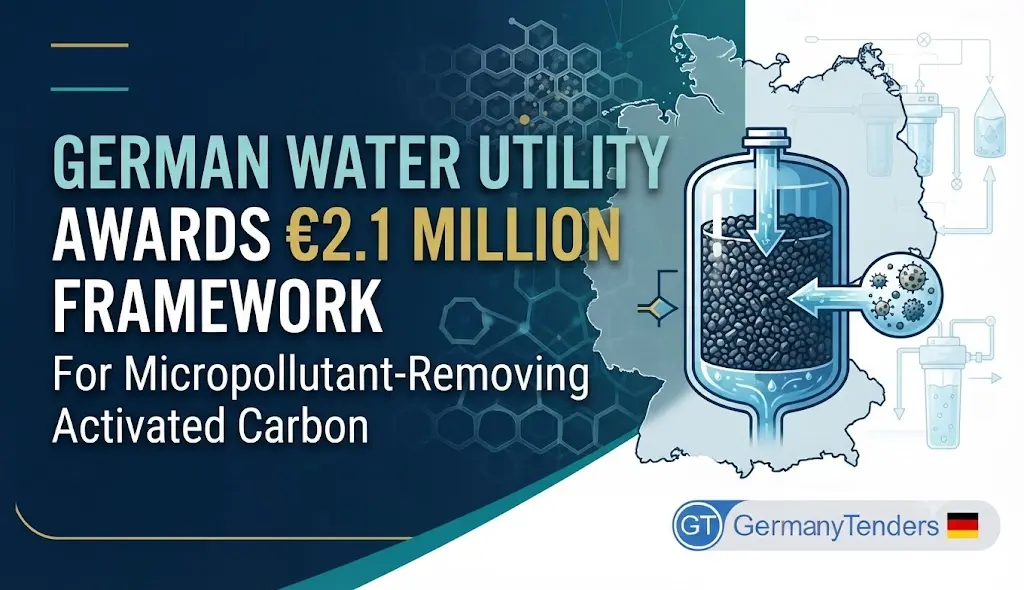
German Water Utility Locks In €2.1 Million Framework for Micropollutant-Removing Activated Carbon
10 Jul 2026
Ruhrverband, the public body responsible for wastewater treatment across the Ruhr river basin, has awarded a two-lot framework agreement worth up to €2.11 million for powdered activated carbon used to strip pharmaceutical residues and other trace pollutants from treated wastewater. The four-year deal, with an option for a further year, was split between chemicals distributor Brenntag GmbH and specialist producer Silcarbon Aktivkohle GmbH, covering treatment plants in Arnsberg-Neheim, Bestwig-Velmede and Brilon.IntroductionWastewater treatment plants across Germany are under growing pressure to remove not just conventional pollutants but also traces of pharmaceuticals and other micropollutants before water is returned to rivers. In the Hochsauerlandkreis district of North Rhine-Westphalia, that task now falls to Brenntag GmbH and Silcarbon Aktivkohle GmbH, after Ruhrverband, the regional body that manages water quality across the Ruhr catchment, concluded a new supply framework for powdered activated carbon.The contract is not a large one by infrastructure standards, but it keeps a specific piece of environmental infrastructure running: the dosing systems that inject activated carbon into the water stream to adsorb trace substances such as diclofenac, carbamazepine and other compounds that conventional treatment does not fully remove.Why This Contract MattersGerman wastewater operators are increasingly required to add an advanced treatment stage aimed specifically at trace substances, particularly residues from medication that pass through the human body and conventional treatment largely unchanged. Powdered activated carbon dosing is one of the principal technologies used to meet that requirement, and this contract illustrates how individual treatment plants secure a steady, contractually guaranteed supply of the material rather than buying it on the spot market.For Ruhrverband, splitting the requirement into two lots, one covering the larger Arnsberg-Neheim and Bestwig-Velmede plants and a smaller one for Brilon, allowed different suppliers to compete for volumes suited to their production and logistics capacity, while still awarding both lots under the same evaluation structure.Contract Timeline● Framework agreement established under prior notice: 127259-2026● Contract award notice published: 10 July 2026 (OJ S 131/2026)● Winners selected: 29 May 2026● Contract concluded: 9 June 2026● Coverage start date: 1 August 2026● Coverage end date: 31 July 2027 (optional one-year extension available)Contract OverviewRuhrverband's central purchasing unit (Abteilung Zentrale Dienste, Einkauf), based in Essen, ran an open procedure for the supply of powdered activated carbon, publishing the call for competition under EU Directive 2014/24/EU and Germany's VgV procurement regulation. Eleven tenders were submitted for the procedure, all electronically, with six coming from micro, small or medium enterprises and one from a tenderer registered in another European Economic Area country.The contract was structured as a framework agreement without reopening of competition, meaning the winning suppliers deliver call-off orders directly for the duration of the term rather than the plants re-tendering individual deliveries. No dynamic purchasing system was used.Key Contract Details Detail Information Contracting authority Ruhrverband, Abteilung Zentrale Dienste, Einkauf (Essen, Germany) Contract subject Powdered activated carbon, CPV 24954000 Procedure type Open procedure Legal basis EU Directive 2014/24/EU; German VgV Number of lots 2 Maximum framework value (both lots) €2,110,000.00 Value of contracts awarded (this notice) €1,020,860.00 Contract duration 1 August 2026 – 31 July 2027, optional one-year extension Tenders received (per lot) 11 (6 from SMEs; 1 from another EEA country; 0 from outside the EEA) EU funding None disclosed Covered by GPA Yes Contract concluded 9 June 2026 Lot-by-Lot Breakdown Detail Lot 1 – Arnsberg-Neheim & Bestwig-Velmede Lot 2 – Brilon Target trace substances Diclofenac Carbamazepine, diclofenac, metoprolol, clarithromycin, sulfamethoxazole, 1H-benzotriazole Estimated annual quantity 195 t (Arnsberg-Neheim) + 150 t (Bestwig-Velmede) 22 t Total contracted quantity 345 tonnes 22 tonnes Framework ceiling (max. value) €2,000,000.00 €110,000.00 Winning bidder Brenntag GmbH Silcarbon Aktivkohle GmbH Bidder size Large enterprise Medium enterprise Optional extension One further year One further year Project ScopeLot 1 covers the delivery of powdered activated carbon to the Arnsberg-Neheim and Bestwig-Velmede wastewater treatment plants, where the goal is full-stream elimination of the trace substance diclofenac, a common anti-inflammatory drug residue. Estimated annual volumes are 195 tonnes for Arnsberg-Neheim and 150 tonnes for Bestwig-Velmede, for a combined 345 tonnes across the lot.Lot 2 covers the Brilon treatment plant, where the target list is broader: carbamazepine, diclofenac, metoprolol, clarithromycin, sulfamethoxazole and 1H-benzotriazole, a mix of an anticonvulsant, an antibiotic, a beta-blocker and an industrial corrosion inhibitor, reflecting the wider range of pharmaceutical and chemical residues found at that site. Estimated annual quantity for Brilon is 22 tonnes.Both lots carry an option for a single one-year contract extension beyond the initial term running from 1 August 2026 to 31 July 2027, giving Ruhrverband flexibility to continue with the same suppliers without re-running the procurement.About the Contracting AuthorityRuhrverband is a body governed by public law, controlled by local authorities, responsible for environmental protection and water management across the Ruhr river catchment in North Rhine-Westphalia. Its remit includes operating and maintaining wastewater treatment infrastructure, which brings with it the recurring need to procure treatment chemicals such as activated carbon under EU public procurement rules.About the Winning CompaniesBrenntag GmbH, awarded Lot 1, is a large chemicals distribution company headquartered in Essen. Its scale and logistics network position it to supply the larger combined volume required for the Arnsberg-Neheim and Bestwig-Velmede plants.Silcarbon Aktivkohle GmbH, awarded Lot 2, is a medium-sized enterprise based in Kirchhundem, specialising in the production of activated carbon. Its smaller scale is well matched to the more modest 22-tonne annual requirement at the Brilon plant, and its specialisation in activated carbon manufacturing itself is relevant to a lot with a broader target-substance list.Procurement AnalysisProcedure: An open procedure was used, allowing any interested supplier to submit a tender without a separate qualification stage, consistent with a standardised commodity-like supply such as activated carbon.Competition: Eleven tenders were received for the procedure, with six from micro, small or medium enterprises, indicating a reasonably competitive and accessible market for this class of supply.Evaluation criteria: Both lots were awarded on the same weighting: price, expressed as the net annual scoring total (Wertungssumme), counted for 80%, while the elimination rate achieved counted for 20%. Price therefore dominated the award decision, with technical performance acting as a secondary differentiator.Framework structure: Both lots were awarded as framework agreements without reopening of competition, meaning the named suppliers deliver directly for the duration rather than facing repeated mini-competitions.GPA status: Both lots fall under the World Trade Organization's Government Procurement Agreement, meaning the procedure was, in principle, open to qualifying international bidders, though both winning suppliers are based in Germany.Additional Procurement Facts● The contract references a prior framework notice (127259-2026) that established the arrangement before this result notice recorded the award.● The procedure was not accelerated, indicating a standard timeline was followed.● No dynamic purchasing system was used.● Neither lot is financed with EU funds.● Disputes or review requests fall to the Vergabekammer Rheinland in Cologne, subject to strict complaint deadlines under section 160(3) of the German Act against Restraints of Competition (GWB).● The value of the tenders themselves is recorded nominally at €0.01, reflecting that actual spend depends on volumes drawn down under the framework rather than a single fixed price.Market & Industry PerspectivePowdered activated carbon dosing is one of the standard technologies German wastewater operators use to meet advanced, fourth-stage treatment requirements aimed at pharmaceutical residues and other trace substances. As more plants across Germany and the wider EU come under similar obligations, recurring supply contracts of this kind are likely to become a steady, if unglamorous, segment of the specialty chemicals market.For suppliers, the structure rewards those who can combine competitive pricing with a demonstrable elimination rate, the two variables weighted in this award, while also maintaining the logistics capacity to service treatment plants on a continuous dosing schedule.Economic SignificanceAt up to €2.11 million combined across both lots, the framework is modest in absolute terms, but it directly supports Ruhrverband's ability to meet environmental treatment obligations at three plants. Without a secured supply of activated carbon, a treatment plant's ability to consistently hit elimination targets for regulated trace substances would be at risk.The optional one-year extension on both lots also gives Ruhrverband flexibility to continue with proven suppliers without immediately re-running a competitive procedure once the initial term ends in July 2027.Future Procurement OpportunitiesShould Ruhrverband exercise the one-year extension option on either lot, Brenntag GmbH and Silcarbon Aktivkohle GmbH would continue supplying without a new tender. Beyond this specific award, other German water authorities operating similar fourth-treatment-stage infrastructure are likely to run comparable activated carbon procurements on their own cycles, and this notice may serve as a reference point for how such contracts are structured and priced.Opportunities for SuppliersActivated carbon producers and distributors active in the German water sector should note that this type of contract recurs predictably as more treatment plants adopt advanced trace-substance elimination, offering a relatively stable, non-cyclical revenue stream. Given the 80/20 price-to-quality weighting used here, suppliers that can combine competitive pricing with a strong, verifiable elimination rate appear best positioned.What Businesses Should Watch● Whether Ruhrverband and comparable German water authorities exercise optional contract extensions once initial terms expire in mid-2027.● Whether other regional water bodies adopt similar price-and-elimination-rate weighted criteria in upcoming activated carbon tenders.● How broader regulatory requirements on micropollutant removal across the EU shape future demand for this class of supply contract.TendersOnTime Procurement IntelligenceThis award is a useful illustration of how environmental compliance translates into recurring, relatively low-profile procurement activity. Ruhrverband's need to remove pharmaceutical residues from treated wastewater is not new, but sourcing the material that makes that removal possible, powdered activated carbon, still has to go through a competitive, rules-based process each time an existing supply arrangement runs out.The split into two lots, with two different suppliers, also shows how a buyer can size a procurement to match the market: a large distributor for the bigger combined volume, and a specialist mid-sized producer for a smaller, more chemically complex requirement. As more plants across Germany and the EU add similar treatment stages, this two-lot pattern, price-weighted but with a real technical criterion attached, looks like a template other public water bodies may follow.Supplier Takeaways● Activated carbon supply contracts tied to trace-substance elimination are likely to recur as German and EU wastewater treatment rules tighten.● Price carried 80% of the award weighting here, but the 20% elimination-rate criterion still needs to be credibly demonstrated to win.● Splitting large requirements into lots by plant size or complexity, as Ruhrverband did, can open opportunities for both large distributors and specialist mid-sized producers.● Framework agreements without reopened competition offer multi-year revenue certainty once won, plus the possibility of an extension.● Actual contract value depends on drawdown volumes, so suppliers should look past the nominal €0.01 tender value to the underlying quantity estimates.Key Takeaways● Ruhrverband awarded a two-lot activated carbon supply framework worth up to €2.11 million to Brenntag GmbH and Silcarbon Aktivkohle GmbH.● The contract runs from August 2026 to July 2027, with an option for a further year.● Eleven tenders were received, evaluated on 80% price and 20% elimination rate.● Lot 1 covers Arnsberg-Neheim and Bestwig-Velmede plants targeting diclofenac; Lot 2 covers the Brilon plant targeting six trace substances.● Both lots were awarded as framework agreements without reopened competition.ConclusionThis is not a contract that will draw national attention, but it reflects a steady, structural part of how German water utilities keep pace with environmental treatment obligations. By securing powdered activated carbon through a competitively tendered framework, Ruhrverband ensures its treatment plants in Arnsberg-Neheim, Bestwig-Velmede and Brilon can continue removing pharmaceutical residues and other trace substances from the water they return to the environment. Brenntag GmbH and Silcarbon Aktivkohle GmbH now carry that supply responsibility through at least July 2027, with a further year possible beyond that.Frequently Asked QuestionsQ1. What is powdered activated carbon used for in this contract? It is dosed into the wastewater stream at treatment plants to adsorb and remove trace substances, mainly pharmaceutical residues, that conventional treatment does not fully eliminate.Q2. Why was the contract split into two lots? Lot 1 covers the larger combined volume needed at the Arnsberg-Neheim and Bestwig-Velmede plants, while Lot 2 covers the smaller, more chemically varied requirement at the Brilon plant, allowing different-sized suppliers to compete for each.Q3. Why was price weighted so heavily in the award criteria? The contracting authority set price (the net annual scoring total) at 80% of the award decision and the elimination rate at 20%, meaning cost was the dominant factor but suppliers still had to meet a technical performance bar.Q4. Is this contract funded by the EU? No. Neither lot is financed with EU funds, though the procurement follows EU Directive 2014/24/EU and is covered by the WTO's Government ProcurementAgreement. Q5. Can the contract be extended? Yes. Both lots include an option for a single one-year extension beyond the initial term ending 31 July 2027.Source: EU Official Journal, Contract Award Notice 478334-2026-EN, OJ S 131/2026, published 10 July 2026.
View Details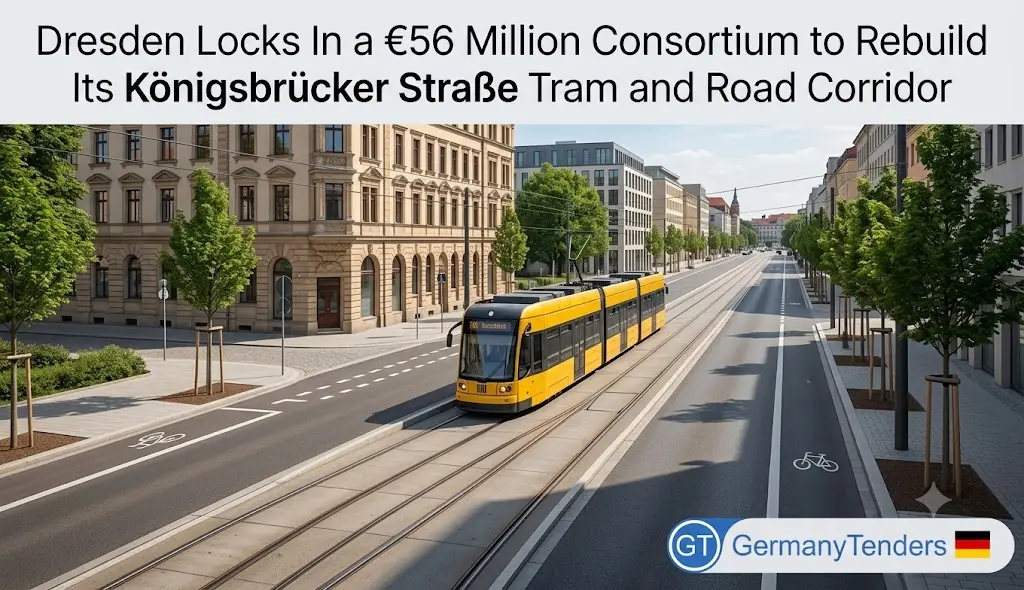
Dresden Locks In a €56 Million Consortium to Rebuild Its Königsbrücker Straße Tram and Road Corridor
09 Jul 2026
A public buying group led by the City of Dresden has awarded a four-year works contract worth almost €56 million to rebuild one of the city's key tram and road arteries between Albertplatz and Stauffenbergallee. The winning bid, submitted by a construction consortium of EUROVIA, Wolff & Müller and STRABAG, covers everything from tram track and street rebuilding to sewers, a new tram power substation, and utility works for five separate infrastructure operators.IntroductionKönigsbrücker Straße is one of Dresden's principal north–south corridors, carrying tram lines, road traffic, cyclists and pedestrians through the city's Neustadt district. Rebuilding a stretch of that scale means far more than resurfacing a road: tram tracks, sewers, drinking water, gas, district heating, telecoms and power infrastructure all sit beneath or alongside the carriageway, and all of it ages at different rates.A joint buying group representing the city's road authority, its wastewater utility, its transport operator and three separate utility companies has now awarded the first major works package for that rebuild. The contract, covering the southern section of Königsbrücker Straße between Albertplatz and Stauffenbergallee, went to a three-firm construction consortium for just under €56 million.Why This Contract MattersLarge urban infrastructure renewals rarely involve a single buyer. This procurement is a case study in how German cities coordinate simultaneous works among a road authority, a sewage utility, a transit operator and multiple private utility companies, so that a street is dug up once rather than repeatedly over several years.For the construction sector, it also illustrates how the largest urban infrastructure jobs increasingly go to multi-firm consortia rather than single contractors, spreading both the technical scope, tram engineering, deep drainage, road building, and the financial risk of a multi-year, nine-figure commitment across several balance sheets.Contract Timeline• Internal reference: 2025-66-00039• Notice published: 9 July 2026 (OJ S 130/2026)• Contract concluded: 1 July 2026• Works start date: 7 September 2026• Estimated completion: 5 April 2030Contract OverviewThe contracting side is a joint buying group ("AGG") made up of the City of Dresden's Straßen- und Tiefbauamt (road and civil engineering authority), the municipal wastewater utility Stadtentwässerung Dresden GmbH, transit operator Dresdner Verkehrsbetriebe AG, and three utility companies acting through representatives: Vodafone Deutschland GmbH, Telekom Deutschland GmbH (via Deutsche Telekom Technik GmbH) and DREWAG Stadtwerke Dresden GmbH (via SachsenEnergieBau GmbH).The buying group ran an open procedure under German public works procurement rules (VOB/A-EU) and received two tenders, both submitted electronically. One came from a tenderer classed as a micro, small or medium enterprise. The contract was awarded purely on price, and the group signed with the winning bidder on 1 July 2026.Key Contract Details Detail Information Contracting authority AGG Dresden: Straßen- u. Tiefbauamt, Stadtentwässerung Dresden GmbH, Dresdner Verkehrsbetriebe AG, Vodafone Deutschland GmbH, Telekom Deutschland GmbH and DREWAG Stadtwerke Dresden GmbH Winning bidder BiGe EUROVIA VB GmbH, NL Dresden / Wolff & Müller / STRABAG AG (consortium) Contract subject Road, tram-track and civil engineering works, CPV 45233120, plus pipeline, sewer, telecom and tramline construction works Procedure type Open procedure Legal basis EU Directive 2014/24/EU; German VOB/A-EU Estimated value (ex-VAT) €60,005,403.16 Value of contract awarded €55,985,519.88 Contract duration 7 September 2026 – 5 April 2030 (approx. 3.5 years) Tenders received 2 (both submitted electronically; 1 from an SME) EU funding None disclosed Covered by GPA Yes Contract signed 1 July 2026 Project ScopeThe works are split across several strands of infrastructure. On the tram and road side, the contract covers new asphalt, mastic asphalt and concrete surfacing across tens of thousands of square metres, alongside new tram track: fixed-slab track, frame track, sleeper track, a level crossing, points, and grooved-rail sections, plus eight tram stops fitted with combi kerbs. Granite paving, granite crust slabs and natural-stone setts feature heavily, reflecting Dresden's traditional streetscape treatment, alongside kerbstones and gutters.A separate strand covers a new rectifier substation ("Gleichrichterunterwerk") for the tram traction power supply, including bored pile retaining walls, sheet-pile bracing, a large excavation, waterproof concrete floor slabs, walls and ceiling slabs, and calcium-silicate masonry.Underground works are extensive: demolition of old shafts, structures and sewer runs; tens of thousands of cubic metres of excavation; new sewer pipes ranging from DN 300 up to DN 1300 in concrete, GRP and PVC-U; new connection sewers; new manholes up to DN 2500; and four special structures. On top of this sits utility work for street lighting, traffic signal systems, tram overhead power, telecoms conduit for Deutsche Telekom and Vodafone, and drinking water, gas and district heating infrastructure for the municipal energy utility.About the Contracting AuthorityThe lead buyer is the City of Dresden's road and civil engineering office, acting on behalf of a joint buying group of public and utility bodies. This structure, common in German municipal infrastructure projects, lets a single procurement and construction programme serve multiple asset owners at once, coordinating disruption to residents and businesses along the corridor rather than running five separate sets of roadworks over several years.About the Winning CompanyThe winning bid came from a construction consortium, or "Bietergemeinschaft", combining EUROVIA's Dresden branch, Wolff & Müller and STRABAG AG. All three are established names in German civil engineering and road construction, and the consortium structure reflects the scale and technical breadth of the project, spanning tram engineering, deep drainage and structural concrete work, that would be difficult for a single firm to resource alone. The lead entity is registered in Radeberg, near Dresden, and is classified as a large enterprise. No subcontracting was declared.Procurement AnalysisProcedure: An open procedure was used, allowing any qualified contractor to submit a tender directly, without a separate pre-qualification stage.Competition: Only two tenders were received, a relatively narrow field for a contract of this value, reflecting how few construction groupings in the region have the combined tram, drainage and structural engineering capacity the project demands.Award criteria: Price was the sole award criterion, weighted at 100 percent, meaning the contract went to the lowest compliant bid rather than being scored on technical or quality factors.Value gap: The winning bid of just under €56 million came in roughly 7 percent below the buying group's own estimate of €60 million, a modest but notable margin for a project of this complexity.GPA status: The contract falls under the WTO's Government Procurement Agreement, meaning it was in principle open to qualifying international bidders, though the winning consortium is entirely German.Additional Procurement Facts•The procedure was not accelerated, indicating a standard timeline was followed.•No framework agreement or dynamic purchasing system was used; this is a single, direct works contract.•All communication in the procedure, including bidder queries and post-award correspondence, was required to run through the eVergabe.de electronic platform.•Disputes or review requests fall to the 1st Chamber for Public Procurement (Vergabekammer) of the Free State of Saxony, based in Leipzig.•Neither tender came from a bidder registered elsewhere in the European Economic Area or beyond it; both received tenders were domestic.Market & Industry PerspectiveLarge German cities are in the middle of a sustained cycle of tram and road-network renewal, much of it involving infrastructure originally built decades ago and now reaching the end of its service life. Coordinating that renewal with parallel utility upgrades, as this contract does, has become the standard model for minimising repeated disruption to the same stretch of street.For contractors, that model rewards firms, or consortia of firms, able to combine tram-specific engineering with conventional road building and deep drainage work, since single-discipline specialists are rarely equipped to bid competitively alone on projects of this scale.Economic SignificanceAt just under €56 million, this is a substantial single works contract even by the standards of major German infrastructure programmes, and it will keep a large multi-disciplinary workforce engaged on one corridor for close to four years. Beyond the immediate construction spend, the project underpins the reliability of a tram line and utility network that residents, businesses and public services along the corridor depend on daily.The multi-year, price-led contract also gives the winning consortium revenue certainty through to 2030, while committing the buying group to a fixed cost for a project whose underlying scope, spanning five separate infrastructure disciplines, would otherwise be difficult to budget for with confidence.Future Procurement OpportunitiesKönigsbrücker Straße's renewal is described in the notice as covering the southern section between Albertplatz and Stauffenbergallee, suggesting further sections or related packages may follow as Dresden continues its broader tram and road modernisation programme. Utility companies and contractors active in Saxony should expect comparable coordinated-works tenders as the city works through its ageing infrastructure inventory.Opportunities for SuppliersThe scale and technical breadth of this contract, tram track, structural concrete, sewer construction and multi-utility coordination, means subcontracting opportunities are likely to open up across the works programme even though the prime consortium declared none at award. Specialist suppliers in rail engineering, natural-stone paving and underground utility works are the segments most directly relevant to the scope described.What Businesses Should Watch•Whether Dresden issues further works packages for adjoining sections of Königsbrücker Straße or comparable tram corridors.•How the consortium structures subcontracting as the four-year programme progresses, despite declaring none at award.•Price-only award criteria on large works contracts, which reward the lowest compliant bid over technical differentiation.TendersOnTime Procurement IntelligenceThis contract shows how German cities manage a structural challenge shared by ageing urban infrastructure everywhere: a street cannot be rebuilt piecemeal, discipline by discipline, without disproportionate cost and disruption. Bringing five separate asset owners, road authority, sewage utility, transit operator and two utility groups, into a single joint procurement solves that by forcing coordinated design and a single construction window.The more interesting signal is the award structure itself. With price as the sole criterion, the buying group prioritised cost certainty over technical differentiation, a rational choice for a well-specified works contract where the engineering requirements, tram gauge, sewer diameters, materials, are already fixed in detail rather than open to competing technical approaches.For contractors, the lesson is that competing successfully on projects of this scale increasingly means forming a consortium capable of covering multiple engineering disciplines at once, rather than bidding as a specialist in any single one.Supplier Takeaways• Coordinated multi-utility works contracts of this kind are becoming the standard model for major German street renewals, worth tracking for pipeline visibility.• Price-only award criteria mean competitive cost control, not technical differentiation, is what wins contracts like this one.•Multi-firm consortium bidding, as seen here, appears to be the preferred structure for the largest, most technically complex urban infrastructure jobs.• Coordinated works spanning tram, road, sewer and utility disciplines offer long-term subcontracting potential even where none is declared at award.Key Takeaways• A Dresden-led buying group awarded a €55.99 million works contract to rebuild Königsbrücker Straße's tram and road corridor to a EUROVIA/Wolff & Müller/STRABAG consortium.•The contract runs for roughly three and a half years, from September 2026 to April 2030.•Two bids were received through an open procedure decided entirely on price.•The project coordinates work for five separate infrastructure bodies, spanning tram track, roads, sewers, a new substation and multiple utilities.•The winning bid came in about 7 percent below the buying group's own cost estimate.ConclusionThis is a large, technically dense infrastructure contract that will not make national headlines, but it reflects how German cities are tackling ageing urban infrastructure: by coordinating multiple asset owners into a single procurement rather than digging up the same street repeatedly. The EUROVIA/Wolff & Müller/STRABAG consortium now carries responsibility for delivering that renewal on one of Dresden's key transit corridors through to 2030.Frequently Asked QuestionsQ1. What is an AGG in this context? It refers to an "Arbeitsgemeinschaft" or joint buying group, here formed by Dresden's road authority together with a wastewater utility, a transit operator, and three utility companies, so that a single works contract covers all their infrastructure needs along one street.Q2. Why does the project include a tram substation? The Königsbrücker Straße corridor carries tram lines, and the works include building a new rectifier substation to supply traction power to the tram network alongside the track and road renewal.Q3. Why was price the only award criterion? For a works contract with a fully specified technical scope, price-only evaluation lets the buying group select the lowest-cost compliant bid without scoring competing technical approaches.Q4. Is this contract funded by the EU? No. The notice confirms the project is not financed with EU funds, though it is governed by EU Directive 2014/24/EU and covered by the WTO's Government Procurement Agreement. Q5. Did any subcontracting take place? No subcontracting was declared by the winning consortium at the time of award.
View Details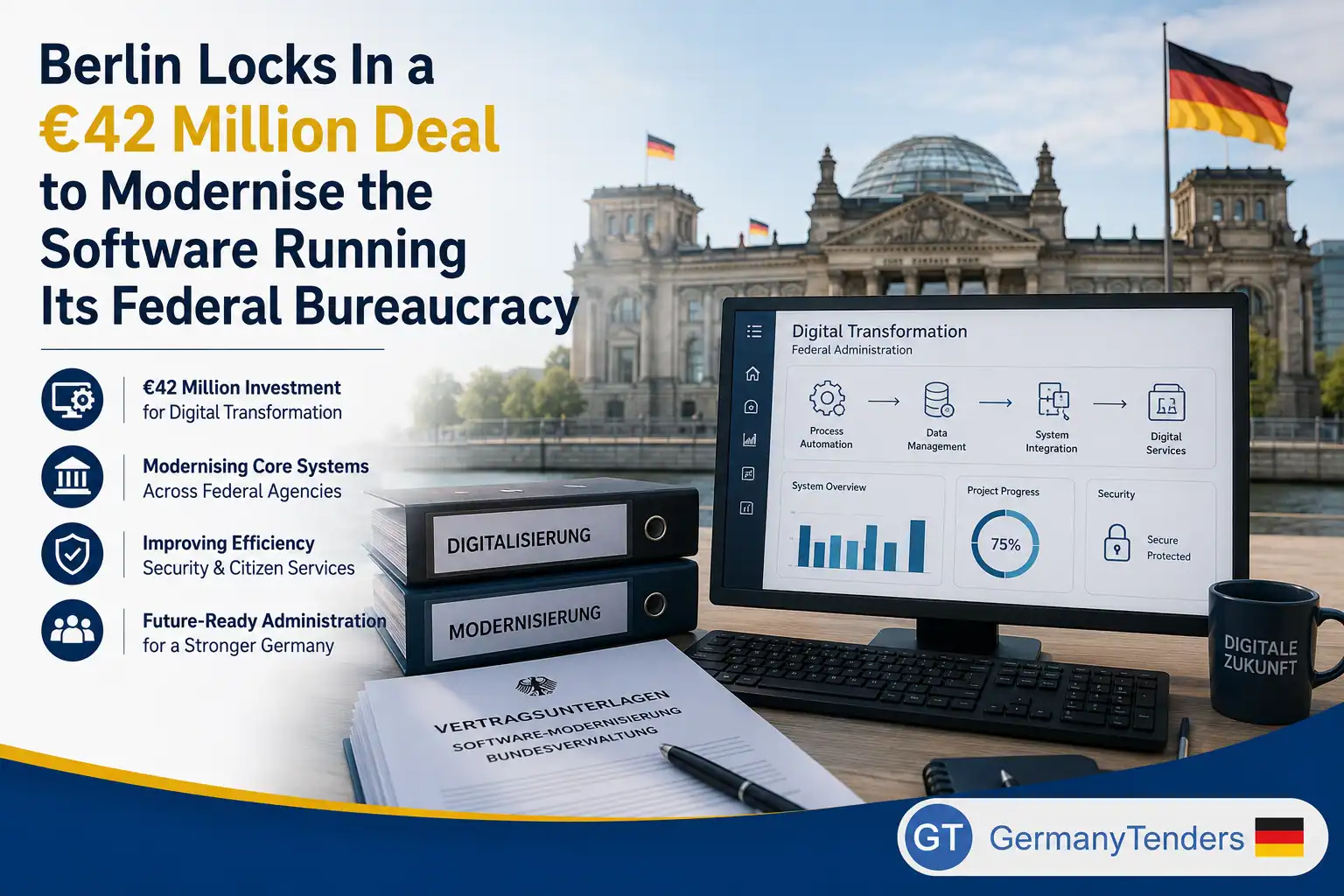
Berlin Locks In a €42 Million Deal to Modernise the Software Running Its Federal Bureaucracy
07 Jul 2026
Introduction Behind every visa processed, benefit approved or federal record updated in Germany sits a piece of software nobody outside government ever sees. Keeping those systems running and building new ones, is a permanent, unglamorous task. Berlin has just handed a significant slice of that task to SEITENBAU, a medium-sized software company from Lake Constance, under a framework agreement that could run as long as six years and be worth up to €42 million. The contract covers "Fachverfahren", a German term for specialist administrative software, the systems that manage day to day casework inside federal authorities rather than the more generic office IT most people picture. Why This Contract Matters Federal governments run on custom software: benefits administration, registry systems, casework tools, none of which come off the shelf. This contract is one of five lots in a broader framework designed to give Germany's Federal Office of Administration (Bundesverwaltungsamt) ongoing access to the developers who build and maintain that software.For industry, it is a signal that Berlin is willing to commit multi year, high value framework spending to mid-sized specialist firms rather than only the largest systems integrators, a meaningful opening for companies with the right technical niche.Contract Timeline Procedure launched: Prior notice referenced under procedure identifier 6748ca3f-7391-4dc5-b00a-0e313cb433c9 Contract concluded: 9 June 2026 Notice published: 7 July 2026 (OJ S 128/2026) Framework duration: Up to 72 months (6 years), running from contract signature until the framework's maximum value is exhausted or 48 months as a base term, extendable twice by 12 months each Contract Overview The buyer is the Beschaffungsamt des BMI, the German Federal Ministry of the Interior and for Community's central procurement office, acting on behalf of the Bundesverwaltungsamt, the federal administrative authority that will actually use the software. The tender was run as an open procedure, meaning any qualified company could bid without a pre-selection stage and it drew four tenders, two of them from small or medium-sized firms.This is Lot 5 of a broader five-lot framework covering IT services in support of federal administrative tasks. The contracting authority has not disclosed details of the other four lots in this notice. Key Contract Details Detail Information Contracting authority Beschaffungsamt des BMI, on behalf of Bundesverwaltungsamt Winning bidder SEITENBAU (Konstanz, Germany) Contract subject Development and maintenance of specialist administrative software (Lot 5 of 5) CPV code 72000000 – IT services: consulting, software development, Internet and support Procedure type Open procedure Legal basis Directive 2014/24/EU Maximum framework value €42,016,806.72 Contract duration Up to 72 months Tenders received 4 (2 from SMEs; 1 from another EEA country; 0 from outside the EEA) Award criteria Quality (50%) and Price (50%) EU funding Partially funded, see below Covered by GPA Yes Framework type Without reopening of competition Contract signed 9 June 2026 Project ScopeThe contract funds ongoing development and upkeep of "Fachverfahren", specialist software applications that support specific casework functions inside federal authorities, as distinct from general-purpose IT infrastructure. Work will primarily be based out of Cologne, the operational home of the Bundesverwaltungsamt, though the notice specifies that deliveries and on-site work may also be required in Hamm, Berlin or other locations, including at the Interior Ministry itself, when specific tasks demand it.Notably, the notice states that the contractor will generally not develop the software on the client's own premises or infrastructure, an indication that SEITENBAU will build much of the system remotely, on its own technical environment, before deployment.The framework's duration is unusually structured: it runs until either the maximum contract value is exhausted or 48 months pass, whichever comes first, with two possible 12-month extensions at the buyer's discretion, capping the total possible term at 72 months.About the Contracting AuthorityThe Beschaffungsamt des BMI is the central procurement body for Germany's Federal Ministry of the Interior and for Community, handling large-scale IT and services purchasing on behalf of federal agencies. In this case it procured on behalf of the Bundesverwaltungsamt, the Federal Office of Administration, which handles a wide range of administrative functions for the German federal government and will be the actual end-user of the software built under this contract.About the Winning CompanySEITENBAU is a medium-sized German software company based in Konstanz, on Lake Constance, close to the Swiss border. The contracting authority has not disclosed further detail on the company's specific technical specialisms beyond its role as the lot's sole confirmed winner.Procurement AnalysisProcedure: An open procedure was used, the most transparent and widely accessible route under EU procurement law, allowing any qualified firm to submit a bid directly without a restricted prequalification round.Competition: Four tenders were received, a healthy field for a specialised federal IT contract. Two came from small or medium-sized firms, one from a tenderer registered elsewhere in the European Economic Area and none from outside the EEA, a pattern consistent with a market where language, legal familiarity and security clearance requirements naturally favour domestic and near-domestic bidders.Evaluation criteria: The contract was decided on an even split, 50% quality (assessed via a named performance metric, "Leistungskennzahl," under the tender's special application conditions) and 50% price. That balance suggests the buyer wanted strong technical delivery capability without simply defaulting to the cheapest bid.Framework structure: The agreement was awarded without reopening competition, meaning SEITENBAU will deliver directly under call-off orders for the life of the contract rather than councils or departments re-competing individual assignments.Foreign Subsidies Regulation: The procedure explicitly falls under the EU's Foreign Subsidy Regulation, meaning bidders had to declare any financial support received from non-EU governments, a relatively new compliance layer aimed at preventing distortion of the EU internal market by subsidised foreign competitors.GPA status: The contract is covered by the WTO's Government Procurement Agreement, formally opening it to qualifying bidders worldwide, though in practice the field remained entirely European.Additional Procurement Facts The notice confirms this is an EU-funded procurement project, with sub-projects under Lots 2 and 3 of the wider framework currently co-financed through the EU's Internal Security Fund; further funding streams are under ongoing review and could extend to other lots, including this one, in future. The contract includes a strategic procurement objective tied to social goals, specifically fair working conditions, with bidders required to submit a self-declaration referencing ILO (International Labour Organization) standards. Bidders were required to submit self-declarations confirming no grounds for exclusion under German competition law (§§123, 124 GWB), plus a specific declaration regarding sanctions against Russia. The contracting authority noted particular sensitivity around ensuring no confidential information is passed to foreign security authorities, with specific contractual clauses addressing this. Procurement documents for this tender were prepared with the assistance of an external law firm, Kremer Legal. Disputes fall under the jurisdiction of the Vergabekammer des Bundes (Federal Public Procurement Tribunal) in Bonn; any challenge to the contract's validity must be filed within 30 calendar days of this notice's publication. Market & Industry PerspectiveFederal government software maintenance contracts of this scale are a stable, recurring feature of Germany's public IT market, rewarding firms that can commit to years-long support relationships rather than one-off project delivery. SEITENBAU's win here places a mid sized specialist alongside the country's largest systems integrators as a credible federal supplier, a competitive dynamic increasingly common in EU public IT tenders, where technical fit and security compliance often outweigh sheer company size.The split five-lot structure of the underlying framework also suggests Berlin deliberately avoided concentrating this work with a single contractor, spreading both risk and opportunity across multiple suppliers.Economic SignificanceAt up to €42 million over as long as six years, this is a substantial, long horizon commitment for a mid-sized software firm and it illustrates how EU internal security funding is increasingly blended into everyday national IT procurement rather than being confined to standalone security projects. The partial EU financing of related lots also signals Brussels' growing role in underwriting the digital infrastructure of national administrations, not just cross-border programmes.Future Procurement OpportunitiesWith funding streams "continuously under review" for other lots, according to the notice, further EU cofinancing could later extend to this Lot 5 contract or its companion lots. The framework's own extension mechanism, two possible 12-month renewals, means SEITENBAU's relationship with the Bundesverwaltungsamt could continue well past the initial term, offering visibility into a recurring revenue stream through the early 2030s.Opportunities for SuppliersIT firms, particularly mid-sized, security-cleared developers, should note that Germany's federal procurement system is actively awarding substantial, multi year framework contracts to companies below systems-integrator scale, provided they can meet quality benchmarks and compliance obligations around foreign subsidy declarations and data confidentiality. The other four lots in this same framework, not detailed in this notice, may represent further live or upcoming opportunities worth investigating directly with the Beschaffungsamt des BMI.What Businesses Should Watch Whether EU Internal Security Fund cofinancing expands to Lot 5 and the framework's remaining lots, as flagged as a possibility in the notice. How the Foreign Subsidy Regulation reporting requirement is applied in practice across future German federal IT tenders, since this is a relatively new compliance layer for bidders. Whether the framework's extension options are exercised, which would extend SEITENBAU's engagement well beyond the initial four-year base term. Germanytenders.com Procurement IntelligenceThis contract is a clear marker of how the EU's Foreign Subsidy Regulation is now showing up as a standard compliance requirement in mainstream domestic IT procurement, not just in flagship cross-border deals. Bidders competing for German federal contracts must now navigate an additional disclosure layer around foreign state support, a compliance cost that larger, internationally backed competitors may find more burdensome than smaller domestic firms like SEITENBAU.The second notable pattern is the blending of security-fund financing into routine administrative software contracts. Framing IT modernisation partly as internal security spending reflects a broader EU trend: digital infrastructure, even for unglamorous back office systems, is increasingly treated as a security and resilience issue rather than pure administrative housekeeping.For suppliers, the strategic lesson is that federal-level IT contracts in Germany are splitting large frameworks into multiple lots rather than awarding single monolithic contracts, a structure that widens the door for firms without the balance sheet of the largest integrators. Companies that can demonstrate both technical delivery quality and clean compliance on subsidy and confidentiality declarations are best positioned as similar multi-lot IT frameworks come to market elsewhere in the EU. Supplier Takeaways Federal IT frameworks split across multiple lots create openings for mid-sized specialists, not just the largest systems integrators. The Foreign Subsidy Regulation is now a live compliance requirement in domestic EU tenders, firms with non EU financial backing should prepare disclosure documentation early. Quality-price splits weighted evenly (50/50) reward technical differentiation, not just cost competitiveness. Security and confidentiality clauses, particularly around foreign authority access to data, are increasingly explicit contract terms worth planning for in advance. EU security-fund co-financing is expanding into conventional administrative IT contracts, a funding source worth monitoring for future lots. Key Takeaways Germany's Beschaffungsamt des BMI awarded a framework worth up to €42 million to SEITENBAU for specialist administrative software development and maintenance. The contract, Lot 5 of a five-lot framework, runs up to 72 months and was concluded on 9 June 2026. Four tenders were received under an open procedure, evaluated equally on quality and price. The framework is partly EU-funded through the Internal Security Fund, with further funding under review. New compliance layers, including the Foreign Subsidy Regulation, applied to this tender. Conclusion This contract shows Germany's federal administration continuing to invest steadily in the specialist software that keeps its bureaucracy functioning, while embedding newer EU level compliance and funding mechanisms into what is, at heart, a routine IT maintenance deal. SEITENBAU's win demonstrates that mid-sized domestic firms remain competitive for substantial federal work when they can meet the technical and regulatory bar, a dynamic likely to recur as Berlin renews similar frameworks in the years ahead. Frequently Asked Questions Q1: What is a Fachverfahren? It refers to specialist administrative software used by German public authorities to manage specific casework functions, distinct from general office IT systems. Q2: Why was the tender split into five lots? The contracting authority has not disclosed its specific reasoning, though multi-lot structures are commonly used to spread risk across several suppliers and widen competition beyond the largest firms. Q3: What is the Foreign Subsidy Regulation? It is an EU rule (Regulation 2022/2560) requiring bidders in public tenders to declare financial support received from non EU governments, aimed at preventing distortion of the EU internal market by subsidised foreign competitors. Q4: Is this contract funded by the EU? Partially. Related lots within the same framework are currently cofinanced through the EU's Internal Security Fund and further funding options for other lots, potentially including this one, are under ongoing review. Q5: How long can the contract run? Up to 72 months in total: a base period ending either when the framework's maximum value is used up or after 48 months, plus two optional 12-month extensions. { "@context": "https://schema.org", "@type": "FAQPage", "mainEntity": [{ "@type": "Question", "name": "Q1: What is a Fachverfahren?", "acceptedAnswer": { "@type": "Answer", "text": "It refers to specialist administrative software used by German public authorities to manage specific casework functions, distinct from general office IT systems." } },{ "@type": "Question", "name": "Q2: Why was the tender split into five lots?", "acceptedAnswer": { "@type": "Answer", "text": "The contracting authority has not disclosed its specific reasoning, though multi-lot structures are commonly used to spread risk across several suppliers and widen competition beyond the largest firms." } },{ "@type": "Question", "name": "Q3: What is the Foreign Subsidy Regulation?", "acceptedAnswer": { "@type": "Answer", "text": "It is an EU rule (Regulation 2022/2560) requiring bidders in public tenders to declare financial support received from non-EU governments, aimed at preventing distortion of the EU internal market by subsidised foreign competitors." } },{ "@type": "Question", "name": "Q4: Is this contract funded by the EU?", "acceptedAnswer": { "@type": "Answer", "text": "Partially. Related lots within the same framework are currently co-financed through the EU's Internal Security Fund and further funding options for other lots, potentially including this one, are under ongoing review." } },{ "@type": "Question", "name": "Q5: How long can the contract run?", "acceptedAnswer": { "@type": "Answer", "text": "Up to 72 months in total: a base period ending either when the framework's maximum value is used up or after 48 months, plus two optional 12-month extensions." } }] }
View Details